
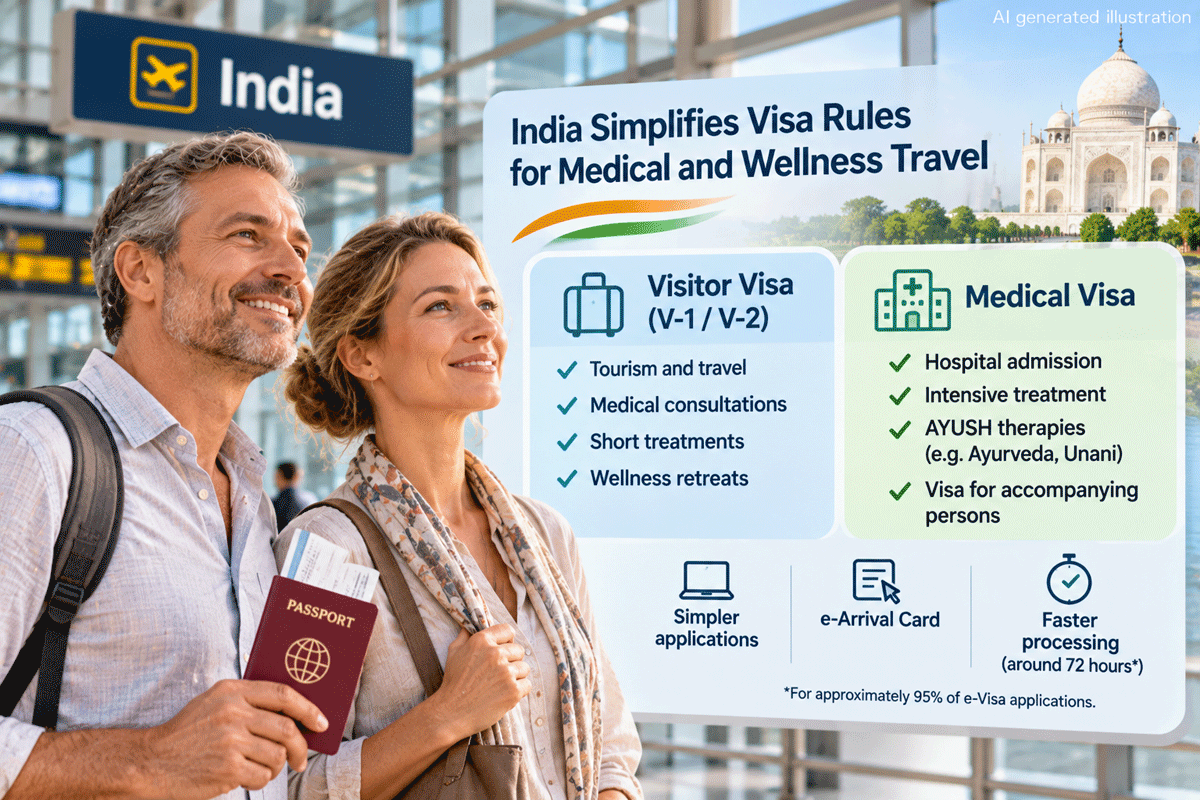
New Visitor Visa categories will allow international travellers to combine tourism with short medical treatments, while a separate Medical Visa will cover more intensive healthcare
India is preparing to simplify entry requirements for international medical and wellness travellers through a major restructuring of its visa system. Under the revised framework, a new Visitor Visa will permit foreign nationals to combine tourism with medical consultations, short treatments and wellness retreats without applying for separate visas for each activity. The changes could make India more accessible to patients seeking outpatient healthcare alongside conventional travel.
The reform forms part of a broader modernisation programme undertaken by India's Bureau of Immigration. The number of principal visa categories was reduced from 22 to 13 in October 2025 and subsequently to nine in August 2026. Subcategories have also been consolidated, falling from 63 to 23. The new system is being introduced progressively, with visas under the revised framework expected to become available by the end of 2026.
For India's international healthcare industry, the changes could simplify travel arrangements for patients seeking medical opinions, diagnostic consultations and relatively short treatment programmes. They also create a clearer distinction between visitors combining healthcare with tourism and those travelling primarily for more intensive medical procedures. The government intends the reforms to support legitimate international travel, including medical value tourism, while maintaining immigration controls.
Visitor Visa broadens access to outpatient healthcare
The new Visitor Visa will replace the existing Tourist Visa and permit a wider range of activities during a single visit.
Its short-term version, designated V-1, will be valid for 30 days and allow multiple entries. Travellers will be permitted to attend business meetings, obtain medical consultations, undergo short medical treatments and participate in wellness retreats.
A second category, V-2, will offer validity periods of one, five or ten years. It will cover the same activities while also permitting mountaineering.
For international patients, the flexibility could be particularly useful when a medical consultation is one component of a wider journey. Travellers may wish to seek a specialist opinion, arrange a diagnostic assessment or receive an outpatient procedure while visiting India for other purposes.
The revised rules could also benefit medical travel facilitators and healthcare providers by reducing uncertainty over the appropriate visa category for shorter visits.
However, the distinction between short treatment and more intensive medical care will remain important. The precise eligibility requirements and permitted activities will need to be assessed against the final official visa guidance as the new system becomes operational.
Medical Visa remains available for intensive treatment
India will retain a separate Medical Visa for patients requiring hospital admission or intensive healthcare.
According to the announced framework, this category will have a standard validity of one year and permit multiple entries, potentially reducing the administrative burden for patients whose treatment involves repeated visits.
The Medical Visa will also cover treatment within India's AYUSH systems, including Ayurveda and Unani medicine. Accompanying persons will continue to have access to dedicated visa arrangements.
This distinction is relevant to India's position as an international medical tourism destination, where healthcare offerings range from specialist hospital procedures to traditional medicine and preventive wellness programmes.
Patients requiring surgery, prolonged treatment or hospital-based care will need to follow the requirements of the Medical Visa rather than assuming that the broader Visitor Visa covers every healthcare service.
The reform does not itself change medical standards, clinical eligibility or the responsibilities of healthcare providers. Appropriate treatment planning, medical documentation and arrangements for follow-up care will remain essential for patients travelling internationally.
Digital procedures aim to reduce administrative barriers
Alongside the restructuring of visa categories, India is simplifying immigration procedures and expanding digital services.
Application forms under the redesigned system contain approximately 70 percent fewer fields, according to the Bureau of Immigration. An electronic arrival card has replaced the previous paper-based landing card, while the existing e-Visa system is available to nationals of 172 countries.
The Bureau reports that approximately 95 percent of e-Visa applications are processed within 72 hours. This figure describes the wider electronic visa system and should not be interpreted as a guaranteed processing time for individual medical travellers.
Additional changes include online transfer of certain existing e-Visas to replacement passports and simplified procedures for resolving some immigration violations.
The reforms are being introduced under the Immigration and Foreigners Act, 2025, which came into force in September 2025 and consolidated several earlier immigration laws.
While the government is seeking to make entry easier for legitimate visitors, the legislation also strengthens immigration enforcement and reporting obligations.
Hotels, educational institutions and hospitals are required to report foreign guests, students and patients electronically within 24 hours. Healthcare providers serving international patients must therefore continue to comply with immigration reporting requirements.
For medical tourism operators, the revised framework creates both opportunities and administrative responsibilities.
India's healthcare sector could benefit from more flexible entry arrangements for international patients, particularly those seeking consultations, preventive examinations and shorter treatment programmes.
The separation of these activities from hospital-based medical care may also help patients and travel organisers identify the appropriate immigration route more easily.
However, the commercial impact will depend on the final implementation of the new visa categories, their practical interpretation and the consistency of application procedures.
For India's medical tourism industry, the most significant change is the prospect of treating shorter healthcare visits as part of a broader international travel experience, while preserving a dedicated visa route for patients requiring more extensive medical treatment.
Image Credit: AI generated illustration