
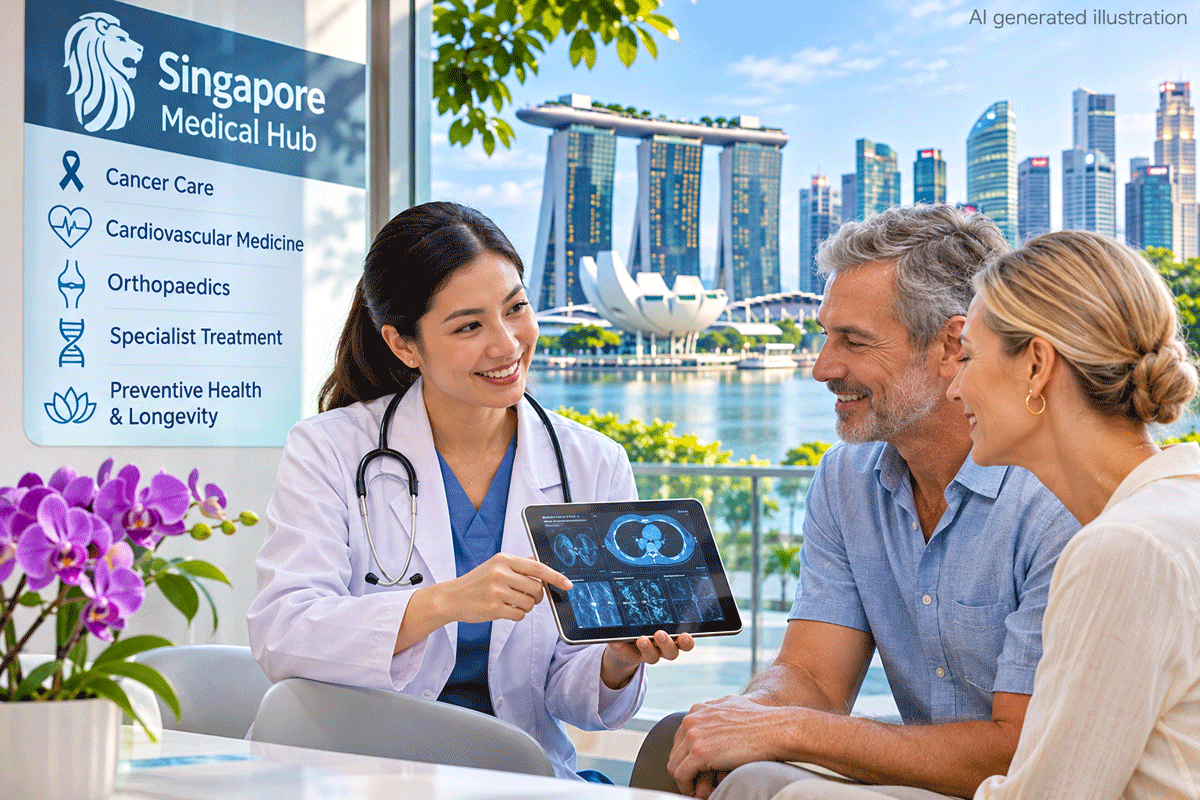
Advanced specialist hospitals, international healthcare networks and a growing preventive medicine sector make Singapore a leading destination for complex treatment and premium health services
Singapore occupies a distinctive position in international medical tourism. The city-state combines highly developed healthcare infrastructure, internationally recognised specialist hospitals and a reputation for clinical quality with one of Asia's most efficient transport and business environments. Unlike destinations competing primarily on affordable treatment, Singapore attracts international patients seeking advanced medical expertise, complex procedures and access to sophisticated diagnostic and therapeutic services.
Its geographical location provides a natural advantage. Situated between Southeast Asia's major population centres and connected to global markets through Changi Airport, Singapore is accessible to patients from Indonesia, Malaysia, China and other parts of Asia. International patients also arrive from more distant markets, particularly when they require specialist consultations or treatment that may not be readily available in their home countries. The country's multilingual environment, with English widely used in healthcare, further supports international patient communication.
Singapore's healthcare tourism industry has evolved alongside its broader transformation into a centre for biomedical research, medical technology and specialised clinical services. Public hospitals, private healthcare groups and university-linked institutions form a closely connected ecosystem. Although the country no longer promotes medical tourism as aggressively as some regional competitors, international healthcare remains an important component of its position as a regional medical hub. Its principal competitive advantages are specialist expertise, clinical infrastructure and continuity of care rather than low prices.
Specialist medicine and internationally connected hospitals
Singapore's healthcare system combines a substantial public hospital network with private institutions serving both residents and international patients. For medical tourists, the private sector is particularly visible because of its dedicated international patient services, multilingual coordination and access to specialist consultations.
IHH Healthcare is one of the most important operators in this market. Its Singapore portfolio includes Mount Elizabeth Hospital, Mount Elizabeth Novena Hospital, Gleneagles Hospital and Parkway East Hospital. These facilities provide a broad range of specialist services, including cardiovascular medicine, oncology, orthopaedics, gastroenterology, neurology and complex surgery.
Mount Elizabeth has long been associated with Singapore's international healthcare sector. Its central location and extensive specialist network make it a prominent option for patients seeking private treatment. Mount Elizabeth Novena, meanwhile, forms part of a modern medical district with specialist practices and hospital facilities.
Raffles Hospital represents another established private healthcare provider. Operated by Raffles Medical Group, it offers multidisciplinary medical services and international patient coordination. Its activities extend beyond Singapore through a regional healthcare network, reflecting the close relationship between the city-state's medical sector and neighbouring Asian markets.
Other private institutions include Farrer Park Hospital, which combines hospital services with a broader medical and hospitality-oriented environment. Specialist clinics throughout Singapore add further capacity in fields such as fertility medicine, ophthalmology, dentistry and preventive healthcare.
The public healthcare system is equally important to Singapore's international medical reputation, particularly in highly specialised treatment.
Singapore General Hospital, National University Hospital and Tan Tock Seng Hospital are major institutions within the country's public healthcare network. Specialist centres such as the National Cancer Centre Singapore, National Heart Centre Singapore and National Neuroscience Institute provide advanced services in their respective disciplines.
These institutions are also closely involved in medical education, research and the development of clinical expertise. However, access for overseas patients depends on individual hospital policies, referral requirements, clinical capacity and applicable payment arrangements.
For patients requiring complex treatment, Singapore's concentration of specialist services can offer advantages in multidisciplinary care. Cancer treatment, for example, may involve medical oncologists, surgeons, radiation specialists, diagnostic teams and rehabilitation professionals working within established clinical networks.
The same applies to cardiovascular diseases, neurological conditions and complicated orthopaedic cases, where treatment planning and postoperative monitoring can be as important as the procedure itself.
Cancer care, cardiovascular medicine and advanced diagnostics
Oncology is among Singapore's most internationally recognised medical specialisations. The country's hospitals offer cancer screening, diagnostic imaging, molecular testing, surgery, chemotherapy, radiotherapy and selected targeted and immune-based treatments.
The National Cancer Centre Singapore is a major institution for cancer treatment and research, while private hospitals provide additional specialist oncology services. The development of advanced treatment technologies and multidisciplinary care has helped establish Singapore as a destination for patients seeking complex cancer management.
Cardiovascular medicine is another important field. The National Heart Centre Singapore and specialist departments in public and private hospitals provide diagnostic cardiology, interventional procedures, cardiac surgery and treatment for complex heart conditions.
Singapore has also developed expertise in organ transplantation, particularly kidney and liver transplantation. However, international patients face specific legal, ethical and eligibility requirements. Transplantation should not be regarded as a conventional medical tourism product, and access depends on strict regulatory and clinical conditions.
Other areas attracting international interest include orthopaedic surgery, neurosurgery, ophthalmology and assisted reproductive medicine. Fertility treatment is available through specialist centres, although eligibility, permitted procedures and regulatory restrictions must be assessed individually.
Advanced diagnostics represent a further strength. Singapore's medical institutions have invested in imaging technology, laboratory medicine and precision diagnostics, supported by the country's wider biomedical research sector.
This connection between clinical medicine and research distinguishes Singapore from destinations whose medical tourism industries are primarily based on routine elective procedures.
Preventive medicine, rehabilitation and urban wellness
Singapore's health tourism offering extends beyond hospital treatment. Preventive medicine, executive health screening and personalised healthcare programmes have become important services within the private medical sector.
Comprehensive health assessments are offered by several major hospital groups and specialist clinics. These may include cardiovascular risk evaluation, metabolic screening, diagnostic imaging and consultations with medical specialists.
The growing international interest in longevity medicine has also encouraged providers to develop programmes addressing healthy ageing, lifestyle-related conditions and preventive healthcare.
However, the clinical value of individual screening tests and longevity interventions varies. Extensive diagnostic packages are not necessarily beneficial for every patient, and some investigations may create unnecessary follow-up procedures. Evidence-based assessment remains essential.
Singapore's broader approach to healthy ageing is reflected in national initiatives such as Healthier SG, which emphasises preventive care and long-term relationships between residents and healthcare providers. Although designed primarily for the domestic population, such policies contribute to the country's wider healthcare environment.
Rehabilitation is another relevant field. Specialist facilities provide neurological, cardiac and musculoskeletal rehabilitation, while physiotherapy and outpatient recovery services are available through hospitals and independent providers.
For international patients, rehabilitation arrangements require particular attention to treatment duration, accommodation and continuity of care after returning home.
Singapore also has a developed wellness and hospitality sector. Luxury hotels, urban spas and wellness-oriented accommodation provide services ranging from relaxation therapies to fitness and nutrition programmes.
Unlike Thailand, Indonesia or Malaysia, Singapore does not possess an extensive network of traditional destination spas or large-scale coastal wellness resorts. Its strengths lie instead in urban accessibility, premium hospitality and proximity to specialist healthcare.
Traditional Chinese medicine also occupies an established place in the local healthcare landscape. Registered practitioners provide services including acupuncture and herbal medicine, subject to Singapore's regulatory framework.
These practices form part of the country's multicultural health traditions, although their effectiveness and safety must be evaluated according to the specific treatment and medical condition.
International patients, quality standards and treatment costs
Singapore's medical tourism market has historically drawn heavily on neighbouring Indonesia, particularly patients seeking specialist consultations and hospital treatment unavailable or less accessible in their home regions.
Malaysia is another important regional connection, while patients from other Southeast Asian countries and wider Asian markets contribute to international demand.
Changi Airport provides extensive international connections, and the country's compact geography simplifies transfers between the airport, hospitals and accommodation.
Singapore's reputation for efficient administration, public safety and reliable infrastructure can be particularly attractive to patients travelling with accompanying family members.
Healthcare regulation is a central element of the country's international positioning. The Ministry of Health oversees healthcare services, while professional regulatory bodies govern medical practitioners and other healthcare professions.
Singapore's Healthcare Services Act provides a licensing framework for healthcare services, with requirements intended to address patient safety and service standards.
Some hospitals also hold international accreditations, although patients should verify the current status of individual facilities. International recognition does not eliminate clinical risks or guarantee treatment outcomes.
Cost is one of Singapore's principal competitive challenges.
Private medical treatment is generally more expensive than in several neighbouring destinations, including Malaysia, Thailand and India. Hospital charges, specialist fees and accommodation costs can all contribute to substantial expenditure.
For complex procedures, the total bill may also depend on intensive care requirements, length of hospitalisation, medical complications and rehabilitation needs.
International patients should therefore obtain detailed treatment estimates and clarify which services are included. Insurance coverage, deposits and payment arrangements require advance confirmation.
Singapore's public healthcare subsidies are primarily designed for eligible residents, meaning international patients generally face different financial conditions.
The country's medical tourism sector also operates within a healthcare system that must meet domestic demand. Maintaining sufficient specialist capacity, controlling healthcare expenditure and ensuring access for residents remain important policy considerations.
Singapore's future competitiveness will depend partly on how effectively it combines advanced clinical services with medical innovation, digital healthcare and personalised treatment.
Its biomedical research ecosystem, supported by universities, research institutions and international pharmaceutical and medical technology companies, provides opportunities for continued development in precision medicine and advanced diagnostics.
At the same time, competition from regional healthcare destinations is intensifying. Malaysia and Thailand offer established international patient services at generally lower prices, while India and South Korea continue to expand their specialist medical tourism capabilities.
Singapore is therefore unlikely to compete successfully through price reductions alone. Its distinctive position rests on the availability of sophisticated medical services, experienced specialist teams, regulatory oversight and internationally connected healthcare institutions.
For patients requiring complex treatment, these advantages may outweigh higher costs. For routine procedures, however, neighbouring destinations may offer more economical alternatives.
Singapore's role in international health tourism is consequently best understood as that of a premium specialist medical hub: a destination where advanced clinical expertise, research capabilities and efficient international connectivity form the foundation of its appeal.
Image Credit: AI generated illustration