
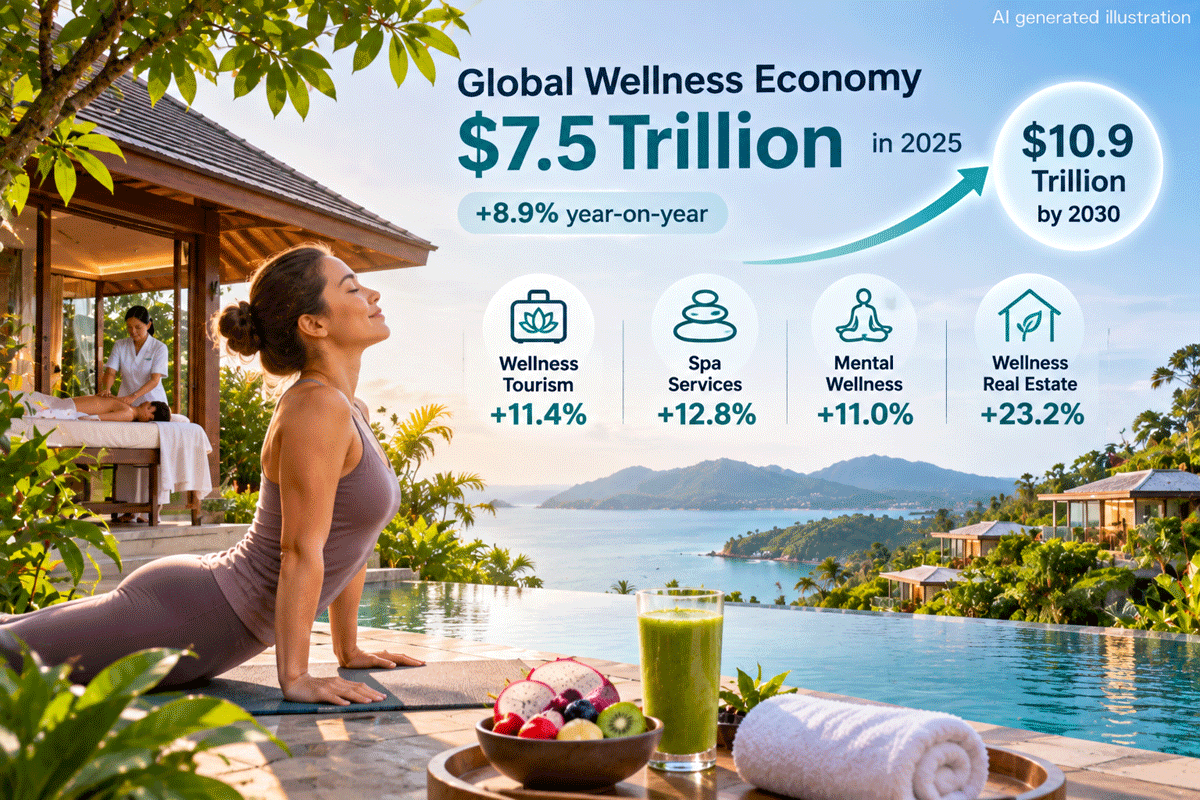
New research from the Global Wellness Institute shows strong expansion in health-oriented travel, spas and mental wellness, with the global market projected to reach $10.9 trillion by 2030
The global wellness economy reached $7.5 trillion in 2025, expanding by 8.9 percent over the previous year, according to the Global Wellness Economy Monitor 2026 released by the Global Wellness Institute (GWI). Presented on November 11 during the Global Wellness Summit in Phuket, Thailand, the study provides new data on the scale and development of industries associated with health, wellbeing and preventive lifestyles.
Wellness tourism was among the strongest-performing sectors, recording growth of 11.4 percent between 2024 and 2025. Spa services expanded by 12.8 percent, while mental wellness increased by 11 percent. Wellness real estate recorded the highest growth rate among the sectors highlighted in the report, rising by 23.2 percent. The figures indicate that demand for health-oriented products and services continues to expand across tourism, hospitality, property development and consumer markets.
Looking ahead, the institute forecasts that the global wellness economy will reach approximately $10.9 trillion by 2030. The projection suggests continued growth in spending on wellbeing, although the overall market encompasses considerably more than tourism or medical services. For international health tourism providers, the findings offer an important economic perspective on the expanding relationship between travel, preventive healthcare, lifestyle management and wellness hospitality.
Wellness tourism emerges as a major growth sector
The 11.4 percent increase in wellness tourism expenditure is particularly relevant for destinations seeking to develop health-oriented travel products.
Wellness tourism includes trips in which maintaining or improving personal wellbeing is an important motivation, as well as wellness activities undertaken during journeys with other primary purposes.
The sector therefore extends beyond specialist health resorts and spa hotels. It can encompass retreats, thermal destinations, nature-based programmes, fitness experiences and accommodation offering structured wellness services.
Its growth reflects opportunities for established tourism destinations to diversify their products and attract visitors interested in health-conscious travel experiences.
For hotels and resorts, wellness facilities are increasingly becoming part of broader hospitality concepts rather than operating solely as optional leisure amenities.
At the same time, specialist providers are developing programmes that combine accommodation with nutrition, exercise, stress management and preventive health assessments.
The distinction between wellness tourism and medical tourism remains important. The GWI's wellness tourism figures should not be interpreted as expenditure on medical treatment abroad, which represents a different segment of international patient mobility.
Similarly, growth in wellness tourism does not establish that all health-oriented travel products deliver measurable clinical benefits.
For destinations, the commercial opportunity lies in developing services that respond to changing consumer preferences while maintaining transparent distinctions between recreation, preventive healthcare and regulated medical treatment.
Spas and mental wellness gain economic importance
The expansion of spa services by 12.8 percent demonstrates the continued commercial strength of a sector closely connected with international hospitality.
Spas remain central to many wellness resorts, but their offerings increasingly extend beyond conventional massage and beauty treatments.
Some operators are incorporating structured relaxation programmes, movement activities, sleep-oriented services and other approaches intended to support physical and mental wellbeing.
The growth of mental wellness is another significant finding.
According to the GWI, the sector expanded by 11 percent in 2025, reflecting rising expenditure on products and services associated with mental wellbeing.
For the tourism industry, this development is relevant to retreats and programmes focused on relaxation, stress management, mindfulness and restorative travel experiences.
However, mental wellness represents a much broader economic category than therapeutic travel. Its market growth cannot be equated with increased demand for clinical mental healthcare or psychiatric treatment abroad.
The distinction is particularly important as commercial providers increasingly use terminology associated with psychological resilience, nervous-system regulation and mental recovery.
While some lifestyle interventions have established benefits for wellbeing, individual commercial programmes require separate evaluation when making specific medical claims.
Wellness real estate leads growth projections
Wellness real estate recorded the strongest expansion among the sectors highlighted in the study, growing by 23.2 percent in 2025.
The category encompasses property developments designed around health and wellbeing considerations, including residential environments and buildings incorporating wellness-oriented features.
Although this market is not synonymous with tourism, it has potential implications for resort development, mixed-use hospitality projects and destinations combining accommodation with health-related services.
The Global Wellness Institute expects wellness real estate to maintain particularly strong momentum, forecasting average annual growth of 15.3 percent through 2030.
Mental wellness is also projected to expand rapidly, with an anticipated annual growth rate of 12.6 percent.
These forecasts suggest that investment in health-oriented environments and services could remain an important feature of the wider wellness economy.
For international tourism developers, the convergence of hospitality, residential property and wellness infrastructure may create opportunities for longer stays and more specialised products.
However, the economic performance of wellness property developments should not automatically be treated as evidence of equivalent growth in medical tourism or healthcare demand.
The success of individual projects will depend on location, accessibility, operating costs, service quality and the ability to attract sustained consumer interest.
Health tourism faces a more specialised market
The findings arrive at a time when international health tourism is becoming increasingly diverse.
Traditional spa destinations, thermal resorts, preventive medicine clinics and medical wellness properties are developing overlapping offerings, often targeting travellers who seek more than conventional leisure experiences.
Longevity programmes, personalised diagnostics, lifestyle medicine and structured recovery services are also gaining attention within the premium wellness market.
These developments create opportunities for cooperation between hospitality businesses and healthcare providers, particularly where programmes involve medical assessments or professionally supervised interventions.
Nevertheless, the expansion of the wellness economy should not obscure important differences between consumer wellbeing services and evidence-based healthcare.
A resort offering advanced diagnostics or longevity programmes does not necessarily provide treatments with demonstrated effects on long-term health or lifespan.
International travellers considering medically oriented wellness programmes should therefore examine professional qualifications, clinical supervision, the evidence supporting proposed interventions and arrangements for follow-up care.
For the industry, transparent communication about these distinctions is becoming increasingly important as health-related terminology spreads across hospitality and tourism marketing.
The GWI's latest figures establish the substantial economic scale of the wellness sector and indicate continued expansion across several of its fastest-growing categories.
For destinations and tourism companies, the 11.4 percent growth in wellness tourism provides a particularly relevant signal of commercial opportunity.
Yet the projected rise from $7.5 trillion in 2025 to $10.9 trillion in 2030 describes the entire wellness economy, not the medical tourism market alone.
The challenge for international health tourism will be to translate this wider economic momentum into credible, clearly defined travel products that combine hospitality quality with appropriate health expertise.
As wellness services become more specialised, destinations that distinguish recreational experiences from clinically supervised healthcare may be better positioned to attract international visitors while maintaining trust and realistic expectations.
Image Credit: AI generated illustration