Government survey shows particularly strong health-related mobility among rural households, while medical journeys generate the highest spending per trip
Health and medical travel represents a major part of domestic travel within India, with around 30 out of every 100 overnight trips in a group of key travel categories undertaken primarily for healthcare purposes, according to new government data.
The findings provide an unusually detailed picture of patient mobility within one of the world’s largest healthcare markets. While India is internationally known as a destination for foreign medical travellers, the figures show that movement within the country for treatment is itself a substantial component of healthcare-related travel.
The National Statistics Office conducted its Domestic Tourism Expenditure Survey between July 2025 and June 2026 as part of the 80th round of the National Sample Survey. A total of 246,113 households were surveyed across India, including 142,603 rural and 103,510 urban households.
Medical travel particularly important in rural India
Among overnight trips completed during the previous 365 days for holiday and leisure, pilgrimage and religious purposes, health and medical care, and shopping, pilgrimage and religious travel accounted for the largest share at around 48%.
Health and medical travel followed with approximately 30 trips out of every 100 across these categories.
The importance of healthcare travel was particularly pronounced among rural households. Health and medical purposes accounted for 38.4% of their overnight trips within the categories covered, making healthcare the second-largest purpose after pilgrimage and religious travel.
The pattern was different among urban households, where holidaying, leisure and recreation represented the second-largest category with a share of 36.4%.
The figures highlight the scale of domestic patient mobility associated with access to healthcare. For many patients, particularly those living outside major urban centres, obtaining treatment can involve travelling beyond their usual environment and staying away from home.
Health trips generate the highest expenditure
Medical journeys also stand out economically.
Health and medical trips generated the highest average expenditure per overnight trip among the categories examined over the 365-day reference period. Rural households spent an average of INR 29,454 per health and medical trip, while expenditure among urban households reached INR 41,649.
The figures include both package and non-package expenditure.
This makes patient travel distinct from many other forms of domestic mobility. The financial impact extends beyond transportation and accommodation because treatment-related journeys can also involve substantial expenditure directly associated with healthcare.
Health and medical travel was also significant among same-day journeys. According to the survey, it generated the second-highest expenditure for same-day trips in both rural and urban areas, behind shopping.
Domestic patient mobility adds another dimension to India’s medical travel market
India’s position in medical travel is frequently viewed through the arrival of international patients seeking treatment in the country. The NSO figures reveal another dimension of the market: large-scale movement of Indian patients within India itself.
The rural figures are particularly significant because they illustrate the scale of healthcare-related travel between communities and medical centres.
For hospitals, diagnostic providers and other healthcare operators, this domestic patient mobility creates requirements extending beyond clinical treatment. Patients travelling for care may also require transport, accommodation and services for accompanying relatives, particularly when specialist procedures involve longer stays.
The findings therefore show that India’s medical travel ecosystem is not limited to international health tourism. Domestic patient journeys form a substantial market of their own, shaped by the geographical distribution of specialist healthcare and the costs associated with accessing it.
The Domestic Tourism Expenditure Survey covered 24,778 first-stage sampling units across India and used a multi-stage stratified sampling design. The survey covered almost the entire country, with only difficult-to-access villages in the Andaman and Nicobar Islands excluded.
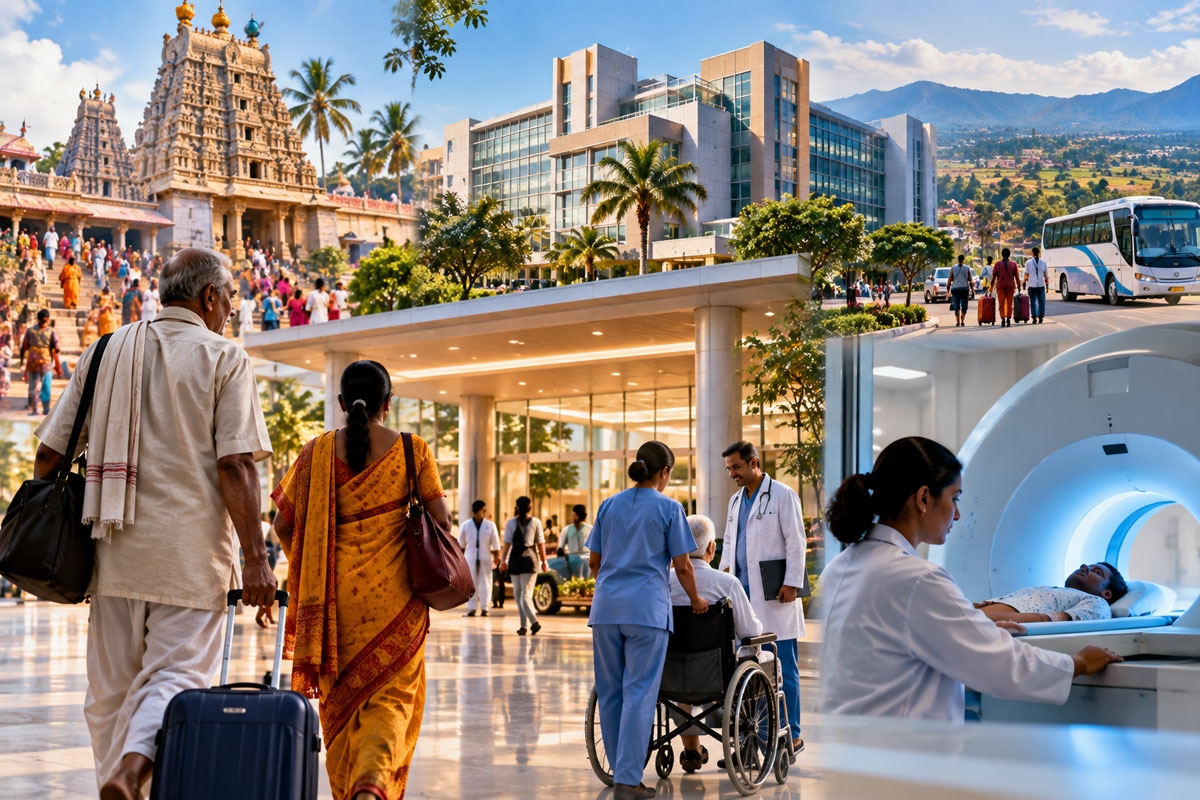
Image Credit: © AI generated illustration