
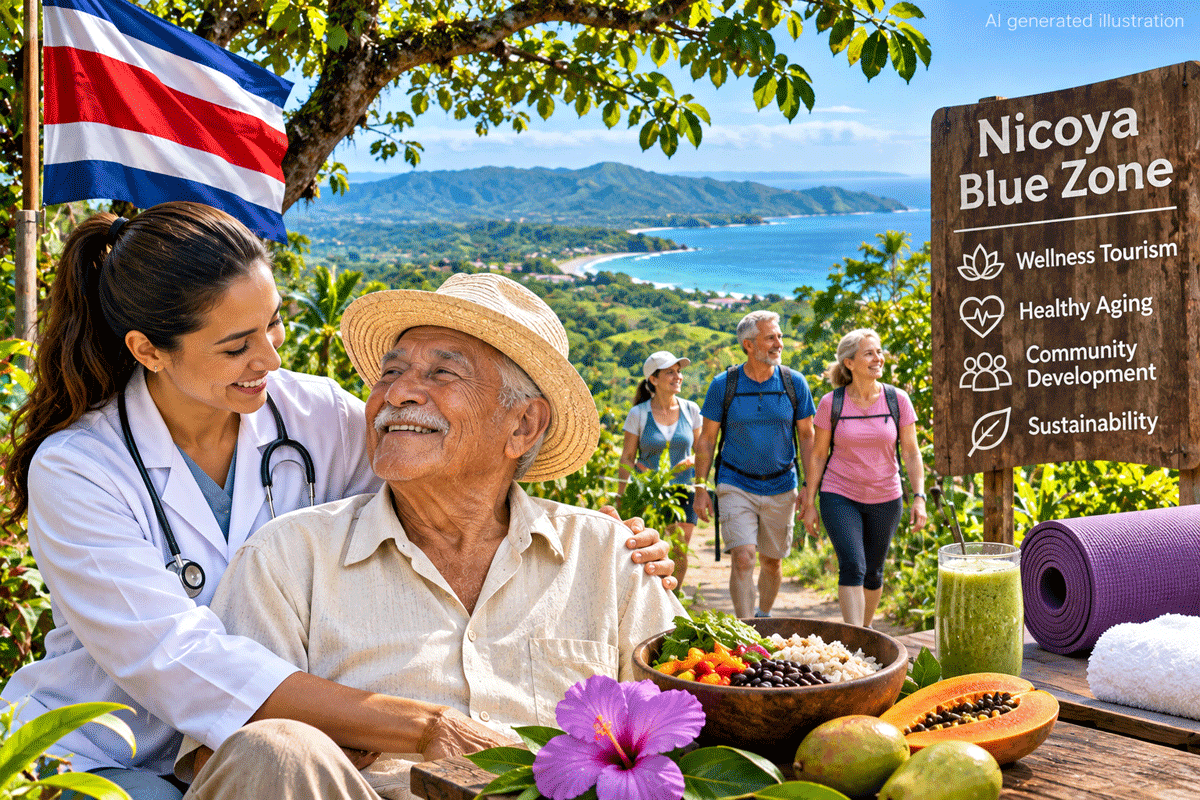
The Costa Rica Centenaria strategy aims to introduce three tourism products by 2028 while expanding healthcare and social support for the region’s oldest residents
Costa Rica is preparing to develop the Nicoya Peninsula into a more structured international wellness tourism destination, with plans for an official Blue Zone seal, three new tourism products and promotional campaigns targeting domestic and international travellers. The initiative forms part of the Costa Rica Centenaria strategy, which combines tourism development with healthcare, social protection and measures to preserve the region’s distinctive longevity heritage.
The strategy was announced by President Laura Fernández Delgado on July 24, 2026, during a visit to Guanacaste. According to the Ministry of National Planning and Economic Policy (MIDEPLAN), the National Council for Older Persons (CONAPAM) will coordinate its implementation. The programme is still undergoing the administrative procedures required for formal adoption, and no overall investment budget has been disclosed.
Nicoya is internationally recognised as one of the world's so-called Blue Zones, regions associated with unusually high numbers of people reaching advanced ages. Its reputation has attracted interest in traditional lifestyles, local diets, social relationships and community structures. However, researchers continue to examine the extent and causes of the region's longevity patterns, including whether they will persist among younger generations.
New tourism products and international promotion
The Costa Rican Tourism Institute (ICT) is responsible for developing the tourism component of the strategy, focusing on experiences connected with wellness, nature, culture and local traditions.
Implementation is planned in several stages. During 2026, authorities intend to establish an interinstitutional working group and conduct a tourism carrying-capacity assessment to determine how visitor growth can be managed without placing excessive pressure on local communities and natural resources.
An inventory of existing wellness tourism services is scheduled for 2027, alongside a national promotional campaign. International marketing activities are planned for 2028, when three new tourism products are also expected to be introduced.
The strategy additionally calls for an official Blue Zone seal. Details of its certification criteria, administration and introduction date have not yet been announced.
The initiative builds on Costa Rica's broader efforts to develop wellness tourism through nature-based experiences, preventive wellbeing activities and cultural encounters. For Nicoya, the challenge will be to transform international interest in longevity into tourism products that provide tangible benefits for local communities.
The planned seal should not be confused with medical accreditation or scientific certification of health benefits. Visiting a region associated with exceptional longevity does not establish that its lifestyle practices or tourism experiences will extend visitors' lives.
Healthcare and social protection for centenarians
An important feature of Costa Rica Centenaria is its parallel emphasis on the wellbeing of the residents whose longevity has contributed to Nicoya's international reputation.
Between 2027 and 2030, CONAPAM plans to establish a National Registry of Centenarians to maintain updated information about Costa Ricans aged 100 and older.
A national support programme delivered through the National Care Network aims to reach all identified centenarians, while expanding daytime care services for older residents.
The Costa Rican Social Security Fund (CCSS) is expected to provide comprehensive geriatric assessments and individual care plans, including medical monitoring, home visits and preventive healthcare measures.
The Ministry of Health also intends to increase participation by municipalities in the high-longevity region in its age-friendly cities and communities programme. The targets are 80% participation in 2027 and full participation by 2028.
Additional healthcare infrastructure measures include two projects to purchase medical equipment for La Anexión Hospital in Nicoya. Both remain in the pre-execution stage. A four-wheel-drive vehicle is also planned for the Nandayure Pain Clinic and Palliative Care Association.
Community development alongside tourism growth
The strategy includes economic initiatives designed to involve rural communities directly in the region's development.
In Pozo de Agua de Nicoya, an agritourism and agroecology project supported by the National Training Institute (INA) involves 22 women livestock producers and 16 women entrepreneurs specialising in traditional cooking. Approximately 152 people are expected to benefit directly.
A second project in Pochote de Quebrada Honda focuses on artisanal fishing and community development, involving 36 organised fishers and shellfish harvesters and an estimated 140 direct beneficiaries.
These initiatives could help connect future tourism experiences with local food traditions, agricultural practices and coastal livelihoods while distributing economic opportunities beyond conventional accommodation and hospitality businesses.
For international wellness tourism, Nicoya offers a distinctive proposition based on cultural heritage, community life and natural surroundings rather than clinical treatment or luxury spa infrastructure alone.
The planned tourism products, certification system and international campaigns could give this positioning a more clearly defined commercial structure. Their eventual impact will depend on implementation, credible standards and the extent to which tourism revenues support the communities and older residents at the centre of the Blue Zone identity.
Image Credit: AI generated illustration