
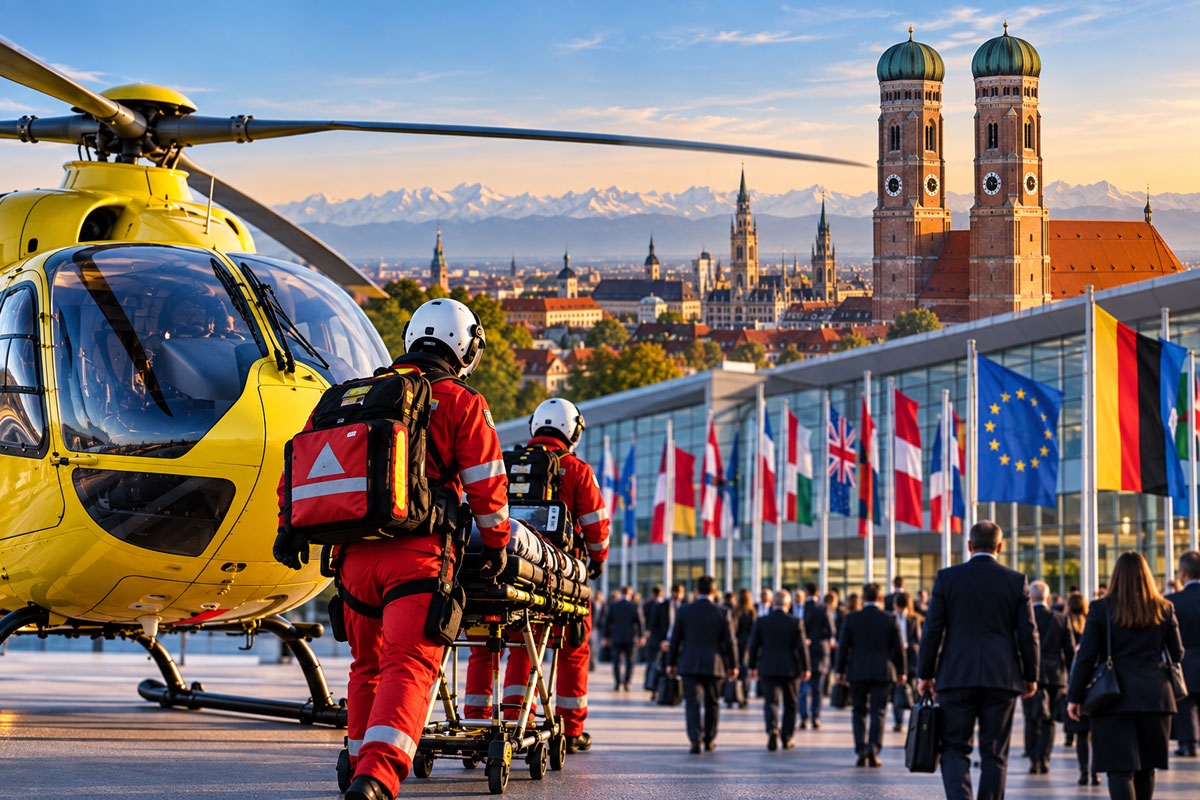
Around 800 experts from 40 countries gather to discuss the future of air rescue, aeromedical care and cross-border cooperation
The AirMed World Congress 2026 has opened in Munich, bringing together around 800 professionals from 40 countries working across aviation, medicine, management, public authorities and industry. Hosted by the non-profit ADAC Luftrettung together with the European HEMS and Air Ambulance Committee (EHAC), the congress focuses on the development of air rescue and aeromedical patient care in an increasingly interconnected international environment.
The opening ceremony also highlighted Munich's historic role in European air rescue. The AirMed World Congress was founded in the Bavarian capital in 1980 and has now returned to its birthplace after 46 years.
WHO highlights the global role of aeromedical care
Bavarian Interior Minister Joachim Herrmann described air rescue as an indispensable part of modern emergency medicine, particularly when patients must be reached quickly in difficult terrain or under challenging operating conditions.
“Air rescue has become indispensable to modern emergency care. It provides rapid, high-quality medical assistance, even in difficult terrain and under challenging operating conditions,” Herrmann said. He stressed that successful operations depend on open communication, mutual trust and the ability to make sound decisions together under intense time pressure.
World Health Organization Director-General Dr Tedros Adhanom Ghebreyesus addressed the congress by video, pointing to the international dimension of emergency care. Emergencies and disasters do not stop at national borders, he said, while everyone deserves access to high-quality emergency care. Aeromedical services can make the decisive difference between life and death.
Munich marks more than five decades of air rescue
Munich occupies a special place in the history of German air rescue. On November 1, 1970, “Christoph 1”, Germany's first permanently operated civilian rescue helicopter, entered service in Munich-Harlaching.
The region remains an important centre for the sector. In 2025, the ADAC Luftrettung Campus opened in Oberpfaffenhofen near Munich as an international competence centre dedicated to the further development of emergency medical services.
“More than 1.3 million HEMS missions and our many years of experience in air rescue form the foundation on which we welcome aeromedical experts from around the world back to Munich, the birthplace of AirMed,” said Frédéric Bruder, Managing Director of ADAC Luftrettung gGmbH.
He added that the congress aims to shape the future of airborne patient care, promote innovation and strengthen international cooperation in emergency medical services.
Air rescue pioneer Erwin Stolpe honoured
One of the opening evening's central moments was the presentation of Bavaria's “Stern der Sicherheit” state medal to Dr Erwin Stolpe for his contribution to emergency medicine and air rescue.
The trauma surgeon served, among other positions, as senior emergency physician aboard the “Christoph 1” rescue helicopter and as Medical Director of ADAC Luftrettung. His work contributed to the development of a helicopter cabin specifically designed around patient care and to the introduction of rescue winches.
“His foresight and his visions were crucial to the development of rapid assistance from the air,” Bruder said. “With the introduction of new international medical standards and the establishment of scientifically supported, evidence-based emergency medicine, he has had a significant influence on European air rescue.”
EHAC marks 25 years of European cooperation
The congress also coincides with the 25th anniversary of the European HEMS and Air Ambulance Committee. EHAC represents air rescue organisations from 18 countries and works to advance common safety, quality and operational standards across European helicopter emergency medical services and air ambulance operations.
Its anniversary reinforces one of the central themes of this year's congress: aeromedical services increasingly depend on cooperation across professional, national and regulatory boundaries.
“The AirMed World Congress 2026 is important for international air rescue because the complex challenges can only be addressed through close cooperation between different disciplines and fields of expertise,” said EHAC President Stefan Becker.
The congress is being held under the theme “Beyond Boundaries: Cross Competence Enhancement of Aeromedical Services”. Becker said the sector must move further away from silo thinking and work across the boundaries separating disciplines, countries and regulatory systems.
Image Credit: © AI generated illustration