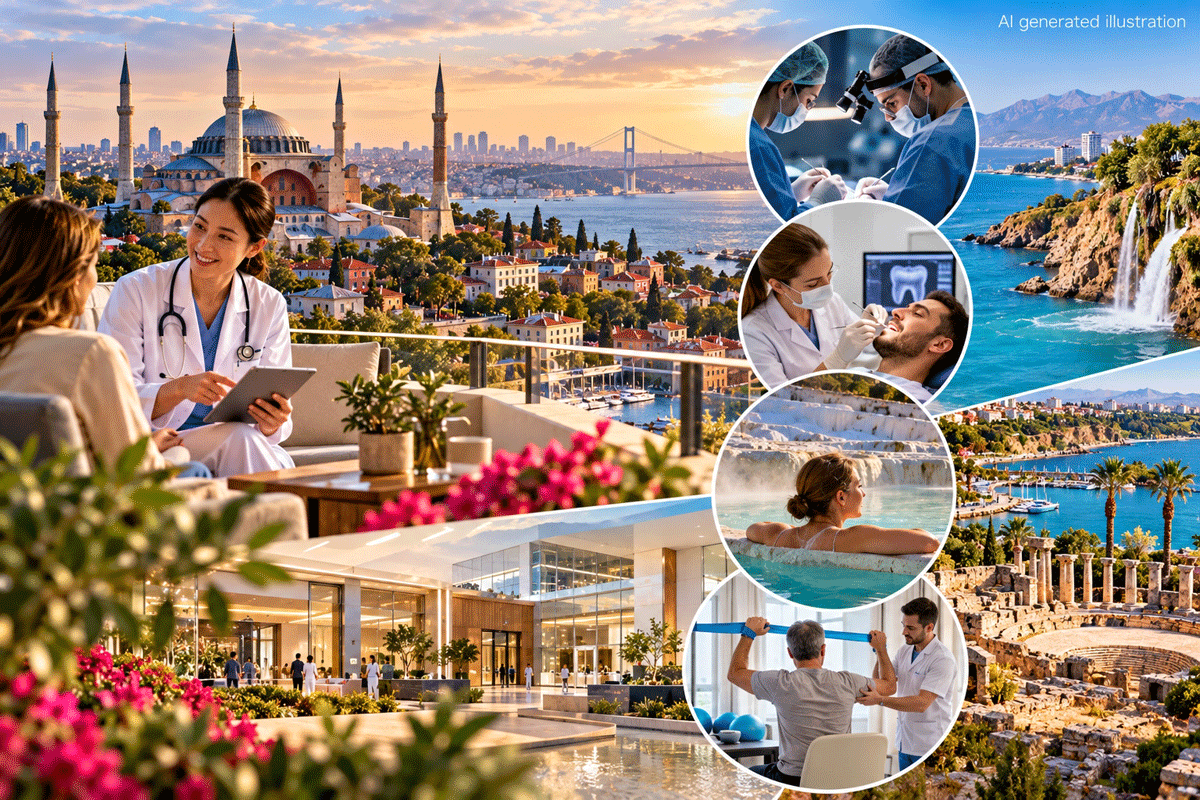
From Istanbul’s international hospital networks to Antalya’s medical travel industry and the country’s thermal spa traditions, Türkiye combines specialist healthcare with an extensive tourism infrastructure
Türkiye has established itself as one of the most prominent destinations for international medical travel, attracting patients seeking surgical procedures, dental treatment, hair transplantation, fertility services and specialist hospital care. Istanbul is the country's principal medical tourism centre, while Antalya, Ankara, Izmir and several thermal spa destinations contribute different services to a market supported by extensive air connections and a large hospitality industry.
The country's position reflects sustained investment in private hospitals, specialist clinics and international patient services. Major healthcare groups operate multidisciplinary hospitals offering complex diagnostics and treatment, while smaller providers concentrate on elective procedures that can be organised around relatively short visits. Competitive prices, geographical proximity to Europe and the Middle East, and direct flights from numerous international markets have helped establish Türkiye as a destination for patients travelling specifically for healthcare.
The sector is nevertheless more complex than its international marketing sometimes suggests. Large tertiary hospitals, licensed specialist centres, dental clinics, hair transplantation providers and wellness establishments operate under different conditions and offer different levels of medical supervision. Türkiye's future competitiveness will depend not only on international demand but also on the quality of care, transparent pricing, effective regulation and arrangements for patients who require follow-up treatment after returning home.
Istanbul anchors the international medical market
Istanbul occupies a central position in Türkiye's health tourism industry. The city combines a large population, university medical centres, private hospital networks and international transport infrastructure. Its hospitals provide services ranging from outpatient diagnostics to cardiac surgery, oncology, neurosurgery, orthopaedics and organ transplantation.
Among the best-known providers is Acıbadem Healthcare Group, which operates hospitals in Istanbul and other Turkish cities. Its flagship institutions include Acıbadem Maslak Hospital and Acıbadem Altunizade Hospital, both offering multidisciplinary medical services and international patient coordination.
Memorial Healthcare Group is another significant participant. Memorial Şişli Hospital was among the early Turkish private hospitals to obtain Joint Commission International accreditation, helping establish international quality assessment as a competitive consideration in the country's private healthcare market. The group provides specialist services across several medical fields, including oncology, cardiovascular medicine and transplantation.
The Medical Park Hospitals Group and its associated Liv Hospital brand also contribute to the country's international hospital infrastructure. Liv Hospital Ulus in Istanbul is particularly associated with specialist private healthcare, while Medical Park operates a broader network of facilities.
Koç University Hospital and the American Hospital in Istanbul add important university-linked and established private healthcare capacity. These institutions illustrate the range of providers available to international patients, from commercially oriented hospital groups to facilities connected with medical education and research.
For patients requiring complex procedures, the choice of institution is more important than the destination's overall reputation. Relevant considerations include the experience of the treating team, access to intensive care, multidisciplinary consultation, complication management and the availability of long-term follow-up.
Hair transplantation, dentistry and aesthetic medicine
Türkiye's international reputation in elective medical travel is closely associated with hair transplantation, dental treatment and aesthetic surgery. These services are widely marketed to patients from Europe, the Middle East and other regions, often through packages combining clinical appointments with accommodation, airport transfers and interpretation.
Istanbul is particularly prominent in hair restoration, with numerous providers offering follicular unit extraction and related techniques. Competition is intense, and the differences between facilities can be substantial. Patients need to establish who will perform each stage of a procedure, whether the provider is appropriately authorised and how complications or unsatisfactory outcomes will be managed.
Dental tourism is another important market. Istanbul, Antalya and Izmir attract patients seeking implants, crowns, veneers and full-mouth rehabilitation. Prices can be lower than in many Western European countries, although comparisons depend on materials, laboratory work, treatment complexity and the number of visits required.
The expansion of dental travel has also raised concerns about aggressive marketing and unnecessarily invasive procedures. Extensive tooth preparation, irreversible treatment and compressed schedules may create long-term problems if clinical indications and follow-up arrangements are inadequate.
Plastic surgery and aesthetic medicine add further international demand, including rhinoplasty, breast surgery, body contouring and non-surgical treatments. These procedures require particular attention to surgical qualifications, anaesthesia, recovery periods and the risks associated with flying soon after an operation.
Antalya connects medical services with resort tourism
Antalya offers a different health tourism environment from Istanbul. Its international airport, large hotel sector and established connections with European source markets make the Mediterranean city attractive for patients who wish to combine planned treatment with accommodation in a familiar holiday destination.
Dental services, ophthalmology, aesthetic procedures and general hospital care contribute to its medical travel market. Antalya's private hospital infrastructure includes facilities associated with national healthcare groups, alongside independent specialist providers.
The region's tourism experience creates opportunities for accompanying relatives and patients requiring accommodation before or after treatment. However, a resort setting should not be confused with medically appropriate rehabilitation. Swimming, sun exposure, excursions and long flights may be unsuitable during recovery from particular procedures.
Izmir also benefits from its coastal location and international accessibility, while Ankara has a stronger concentration of major medical institutions, university hospitals and specialist treatment capacity. Bursa and other industrial cities contribute additional private healthcare services.
Together, these destinations demonstrate that Türkiye's medical tourism industry extends beyond the highly visible elective treatment market in Istanbul.
Thermal medicine and traditional wellness
Beyond modern hospitals, Türkiye possesses a substantial thermal tourism tradition rooted in its geothermal resources and centuries of bathing culture. These assets distinguish the country from medical tourism destinations that concentrate almost exclusively on elective surgery.
Afyonkarahisar is one of the most important centres of Turkish thermal tourism, with hotels and health-oriented establishments built around mineral springs. Pamukkale and nearby Karahayıt combine geothermal landscapes with spa facilities, while Bursa, Yalova and Kütahya have longstanding traditions of thermal bathing and rehabilitation-related services.
Balneotherapy, hydrotherapy and supervised aquatic exercise may be incorporated into physical medicine and rehabilitation programmes. Their suitability depends on the patient's condition, the treatment method and professional supervision. Thermal bathing alone should not be presented as a substitute for established medical treatment.
The traditional Turkish hamam provides a separate cultural and wellness experience. Its appeal lies primarily in bathing rituals, relaxation and hospitality rather than the treatment of specific diseases.
These traditions offer opportunities for longer wellness stays, particularly when combined with suitable accommodation, physical activity and evidence-based rehabilitation services.
Rehabilitation, fertility care and emerging preventive services
Rehabilitation is a less internationally visible but important part of Türkiye's healthcare offering. Specialist hospitals and physical therapy centres provide services for patients recovering from orthopaedic surgery, neurological conditions and other illnesses requiring structured rehabilitation.
For international patients, longer recovery stays can be attractive when accommodation and clinical services are coordinated. However, rehabilitation requires individual assessment and continuity of care, particularly for patients with reduced mobility or complex medical needs.
Türkiye also has an established assisted reproduction sector, with IVF services available at licensed centres. Unlike several European fertility tourism destinations, however, Turkish law restricts assisted reproductive treatment to married couples using their own reproductive cells. Egg donation, sperm donation, embryo donation and surrogacy are prohibited. These restrictions are essential for international patients considering fertility treatment abroad.
Preventive medicine and wellness represent additional areas of development. Private hospitals offer health screening, cardiovascular assessments, metabolic consultations and lifestyle-oriented services, while selected resorts incorporate nutrition, exercise and stress-management programmes.
The expansion of preventive healthcare creates opportunities for cooperation between medical providers and hospitality businesses. Nevertheless, diagnostic screening should be medically appropriate, and commercial longevity treatments require careful evaluation of their clinical evidence.
International demand and government strategy
Türkiye's medical tourism market has reached considerable scale. According to figures based on Turkish Statistical Institute data, approximately 1.40 million visitors travelled to the country for health-related reasons in 2025, generating around USD 3.02 billion in tourism revenue.
The visitor total was lower than the approximately 1.51 million recorded in 2024, while reported revenue remained almost unchanged. This suggests a higher average expenditure per recorded health visitor, although aggregate tourism statistics do not establish the profitability or clinical composition of individual treatments.
The figures also require careful interpretation. Türkiye's health-related visitor statistics include Turkish citizens residing abroad, and they do not represent a count consisting exclusively of foreign nationals purchasing planned private medical treatment.
International demand comes from a diverse range of markets. European countries are important sources for dental treatment, hair transplantation and aesthetic procedures, while patients from the Middle East, neighbouring countries and other regions also use Turkish healthcare services. Turkish communities living abroad provide an additional connection between the country's medical infrastructure and international patient markets.
Air connectivity is a major competitive advantage. Istanbul Airport functions as an extensive international hub, while Antalya, Izmir and Ankara provide further access to regional healthcare markets. Turkish Airlines' international network makes Türkiye reachable from numerous countries without complicated connecting journeys.
The government has sought to strengthen the sector through the HealthTürkiye platform and the activities of USHAŞ, the state-owned international health services company. These initiatives support coordination, international promotion and the development of standards for healthcare providers and medical travel intermediaries.
Regulation has also become more demanding. Rules introduced in April 2025 require healthcare facilities and intermediary organisations engaged in international health tourism to obtain appropriate authorisation. Accreditation requirements administered through Türkiye's Healthcare Quality and Accreditation Institute, TÜSKA, are being introduced for specified categories of providers.
These measures are intended to strengthen oversight in a market where the quality and operating models of individual businesses vary considerably. An international health tourism authorisation certificate, however, should not be confused with proof that a particular treatment will be successful.
Quality and patient protection remain decisive
Türkiye's extensive medical tourism industry offers international patients substantial choice, but this diversity also makes provider selection more complicated.
Major hospitals with multidisciplinary teams and intensive care facilities cannot be assessed using the same criteria as small outpatient clinics or businesses primarily organising elective procedures. Patients should verify professional qualifications, facility authorisation, treatment responsibilities and the availability of emergency support.
Transparent pricing is another important consideration. Advertised packages may not include additional diagnostic examinations, medication, revision procedures, extended accommodation or the management of complications.
Continuity of care is particularly important for patients undergoing surgery or complex dental treatment. Problems may emerge after the patient has returned home, making clear communication between the Turkish provider and local healthcare professionals essential.
The sector also faces reputational challenges associated with aggressive marketing, unrealistic treatment expectations and competition based primarily on price. International patients need reliable information about medical risks and expected outcomes rather than assurances based on promotional testimonials.
Türkiye's broader healthcare system must simultaneously serve its domestic population. The expansion of premium international services creates economic opportunities but also raises questions about the distribution of medical personnel and healthcare resources.
The country's international position rests on a combination of established hospital networks, specialist elective procedures, competitive private healthcare services and an unusually extensive tourism infrastructure. Istanbul remains the principal centre for complex treatment and internationally marketed procedures, while Antalya connects medical services with resort hospitality. Ankara and Izmir contribute specialist hospital capacity, and thermal destinations provide a different foundation for rehabilitation and wellness tourism.
Türkiye's next stage of development will depend on moving beyond patient volume and price competition towards demonstrable clinical quality, stronger patient protection and more coordinated services. Its ability to combine modern healthcare with established tourism assets gives the country significant opportunities, but sustainable international growth will require transparent standards and reliable care before, during and after treatment.
Image Credit: © AI generated illustration