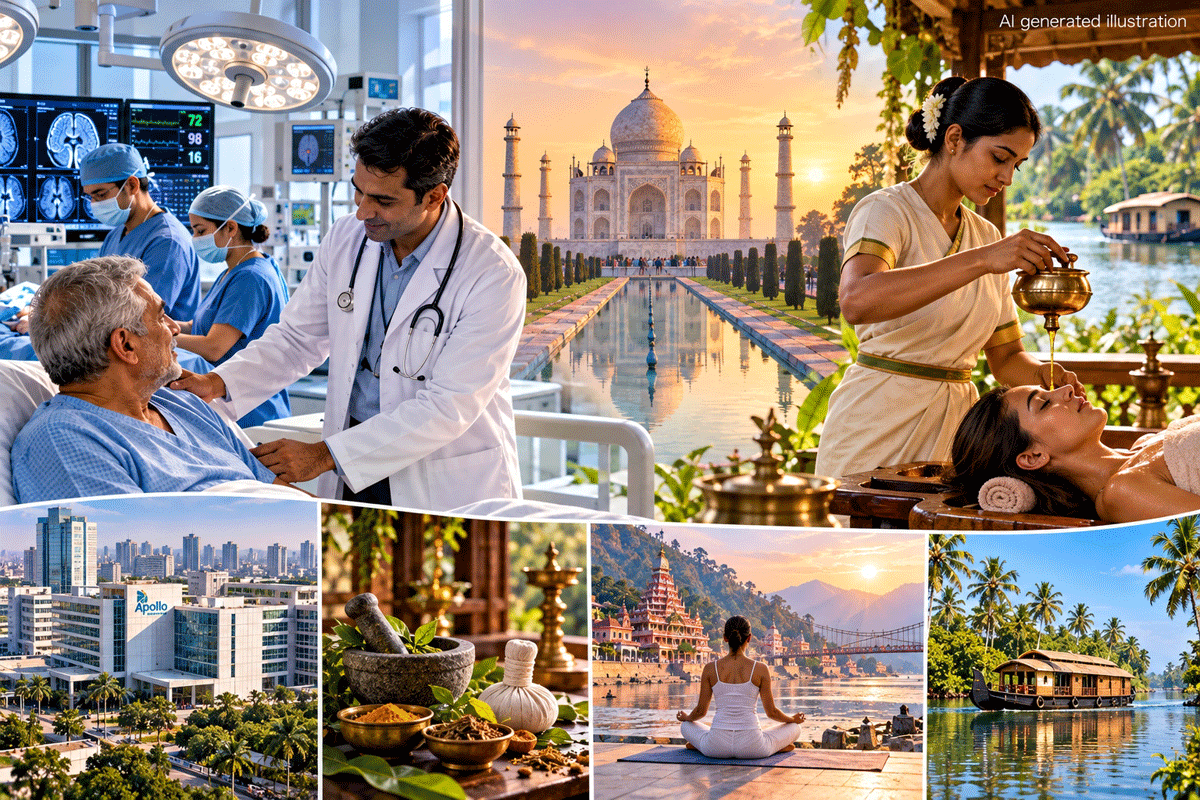
From complex hospital treatment and internationally accredited medical centres to Ayurveda, yoga and rehabilitation, India combines modern healthcare with longstanding wellness traditions
India occupies a distinctive position in international health tourism, attracting patients seeking complex hospital treatment as well as travellers interested in traditional medicine, preventive healthcare and wellness. Its medical travel industry is supported by large private hospital networks, specialist physicians, comparatively competitive treatment costs and an expanding international patient infrastructure. New Delhi, Mumbai, Chennai, Hyderabad and Bengaluru are among the principal centres for advanced medical care.
The country's appeal extends well beyond elective procedures. International patients travel to India for cardiac surgery, oncology, orthopaedics, organ transplantation and other specialised treatments, while established institutions also offer rehabilitation and long-term disease management. At the same time, Kerala, Rishikesh and other destinations attract visitors for Ayurveda, yoga and wellness programmes, creating two overlapping but fundamentally different segments of health-related travel.
India's competitive position reflects both opportunity and complexity. Modern tertiary hospitals operate alongside smaller clinics, traditional medicine centres and wellness resorts, with considerable differences in clinical capabilities, regulation and service standards. For international patients, selecting an appropriate provider requires careful assessment of medical expertise, accreditation, treatment costs and continuity of care. The country's long-term development as a health tourism destination will depend on strengthening these safeguards while making its diverse healthcare services more accessible to overseas visitors.
Major cities anchor complex medical treatment
India's international hospital market is concentrated in major metropolitan areas with established medical education, specialist infrastructure and international transport connections.
The National Capital Region, including New Delhi and Gurugram, is an important centre for advanced treatment. Hospitals such as Medanta – The Medicity, Apollo Hospitals and Fortis facilities offer multidisciplinary services covering cardiovascular medicine, oncology, neurosciences, orthopaedics and organ transplantation.
Medanta in Gurugram has developed a particularly visible position in complex medical care, including cardiac surgery and specialist treatment requiring cooperation between several clinical disciplines. Apollo Hospitals, one of India's largest private healthcare groups, operates institutions across the country and has extensive experience serving international patients.
Chennai is another major medical tourism destination. Its private hospital sector has longstanding expertise in cardiac care, transplantation, orthopaedics and other specialist fields. Apollo Hospitals' flagship institution in Chennai helped establish the city's international reputation, while other providers contribute additional specialist capacity.
Mumbai combines major private hospitals with advanced diagnostic services and specialist treatment. Kokilaben Dhirubhai Ambani Hospital and other institutions offer complex care in fields including oncology, neurology and cardiovascular medicine.
Hyderabad and Bengaluru have also developed significant healthcare infrastructure. Hospitals associated with Apollo, Aster, Manipal and other private groups provide specialist services, while the two cities' international business connections support medical travel from overseas markets.
The presence of large hospital networks is an important advantage, but patients must evaluate individual institutions and treating teams rather than assuming that all facilities within a group offer identical capabilities.
Medical specialties and the cost advantage
Cardiovascular medicine is among India's most established fields in international healthcare. Major hospitals perform coronary bypass surgery, valve procedures and catheter-based interventions, supported by intensive care and specialist diagnostic services.
Oncology is another important area, with comprehensive cancer centres offering surgery, radiotherapy, systemic treatments and multidisciplinary consultation. The availability of advanced technologies varies between institutions, and international patients should establish whether proposed treatments are supported by appropriate clinical evidence.
Orthopaedic surgery, particularly hip and knee replacement, attracts patients seeking alternatives to treatment in higher-cost healthcare markets. Neurosurgery, gastroenterology, ophthalmology and complex diagnostics contribute further demand.
India also has significant organ transplantation expertise. However, transplantation is subject to strict legal safeguards. Foreign donors and recipients require appropriate authorisation, and commercial organ transactions are prohibited. International patients cannot assume that access to a transplant is comparable to booking an elective surgical procedure.
Treatment costs are an important competitive factor. Private hospital charges for selected procedures can be substantially lower than those in Western Europe or North America. Nevertheless, advertised comparisons often exclude diagnostic investigations, complications, additional hospital days and post-discharge care.
For complex medical treatment, the total cost of care and the clinical capabilities of the institution matter more than a headline procedure price.
Ayurveda and yoga create a second health tourism market
India's traditional wellness sector is one of its most distinctive advantages. Ayurveda, yoga and related practices attract international visitors seeking relaxation, lifestyle programmes and experiences connected with Indian cultural traditions.
Kerala is particularly associated with Ayurveda tourism. Destinations around Thiruvananthapuram, Kovalam, Kumarakom and other parts of the state have developed resorts and specialist establishments offering structured programmes, often combining dietary arrangements, massage, daily routines and traditional therapies.
Somatheeram Ayurveda Village near Kovalam is an established example of a resort built around Ayurveda. Other providers, including Kairali Ayurvedic Healing Village in Palakkad, combine accommodation with programmes based on traditional Ayurvedic principles.
Northern India offers a different geographical setting. Rishikesh, situated near the Himalayan foothills, has become internationally associated with yoga, meditation and spiritual travel. Ananda in the Himalayas, near Rishikesh, combines luxury hospitality with yoga, Ayurveda-inspired services and personalised wellness programmes.
Bengaluru and other urban centres also have Ayurveda-related institutions, including providers connected with research, education and clinical practice.
The distinction between traditional wellness and evidence-based medical treatment is essential. Yoga and certain relaxation or movement practices may offer benefits for selected health outcomes, but claims about Ayurvedic treatments vary considerably in scientific support. Herbal preparations can also carry risks, including interactions with prescribed medication and contamination.
International visitors should therefore distinguish between cultural wellness experiences, regulated traditional medicine services and conventional medical care. Serious illnesses should not be managed through unproven treatments in place of established clinical interventions.
India's government promotes Ayurveda and other traditional systems through the Ministry of AYUSH. The sector contributes to the country's international identity, but official recognition of a traditional practice does not establish the effectiveness of every treatment offered under its name.
Rehabilitation and preventive healthcare expand the offering
Rehabilitation represents another area of potential development for India's international healthcare sector. Major hospitals and specialist facilities provide physical medicine, neurological rehabilitation, orthopaedic recovery programmes and services for patients requiring extended treatment.
For international patients recovering from surgery, stroke or other serious conditions, rehabilitation may require several weeks of coordinated care. Facilities must be assessed for multidisciplinary staffing, medical supervision, accessibility and their ability to manage complications.
India also has a substantial domestic market for preventive health examinations. Private hospitals offer cardiovascular assessments, metabolic screening and other diagnostic packages, sometimes marketed to international visitors.
Such services can be convenient when appropriately selected, but comprehensive screening packages are not automatically beneficial. The value of individual tests depends on age, symptoms, risk factors and established clinical recommendations.
Wellness resorts increasingly offer lifestyle programmes involving nutrition, physical activity, sleep and stress management. These services create opportunities for cooperation between hospitals, rehabilitation providers and hospitality businesses, although clinical treatment and recreational wellness require different standards of supervision.
International demand and government strategy
India recorded 507,244 foreign arrivals for medical purposes in 2025, according to government figures published in May 2026. This was below the 644,387 recorded in 2024 and the 659,356 registered in 2023. The figures underline the country's substantial international patient market while showing that demand has not followed an uninterrupted upward trajectory.
Bangladesh is by far the largest source market, accounting for approximately 325,000 medical-purpose arrivals in 2025. Iraq, Uzbekistan, Somalia, Turkmenistan, Oman and Kenya were among the other leading countries. This geographical distribution illustrates the importance of regional healthcare access and established patient connections, rather than suggesting that India's market is driven primarily by travellers from Europe or North America.
The government has made medical and wellness tourism part of its wider economic development strategy. Its Heal in India initiative aims to simplify access to healthcare services for international patients, supported by dedicated medical visas, digital information services and cooperation between hospitals, tourism businesses and public authorities.
The 2026–27 Union Budget also proposed five regional medical hubs involving state governments and private partners. The planned facilities are intended to combine specialist healthcare, education, research, rehabilitation and patient assistance services. Their eventual significance will depend on implementation, investment and operational capacity.
India's National Accreditation Board for Hospitals and Healthcare Providers provides a domestic quality assessment framework, while selected hospitals also hold Joint Commission International accreditation. Patients should verify the current accreditation status of the specific facility rather than relying on the reputation of a hospital group.
International accessibility is supported by major airports in Delhi, Mumbai, Chennai, Bengaluru and Hyderabad. Dedicated e-medical visas and medical attendant visas facilitate eligible travel, while a separate AYUSH visa category supports visits for recognised traditional medicine services.
Quality, regulation and continuity of care
India's medical tourism industry faces challenges associated with differences in hospital standards, patient protection, commercial intermediaries and access to reliable treatment information.
International patients may encounter substantial variations in pricing, clinical capacity and post-treatment services. A hospital equipped for complex cardiac surgery or cancer treatment cannot be evaluated using the same criteria as a wellness resort or outpatient clinic.
For patients undergoing major surgery, arrangements for complication management and follow-up care are particularly important. Long-distance flights after treatment may carry additional risks, while recovery periods can extend beyond the duration of a standard medical travel package.
India must also balance international healthcare development with the needs of its domestic population. Expanding private hospital capacity can support investment and specialist expertise, but geographical and financial inequalities in access to healthcare remain significant.
The country's distinctive position lies in the breadth of its offering. Few destinations combine internationally oriented tertiary hospitals, an extensive private healthcare sector, established yoga and Ayurveda traditions, and a government strategy explicitly linking modern medicine with wellness tourism.
Its future competitiveness will depend on whether this combination produces reliable, accessible services rather than simply a larger range of marketed treatments. Transparent outcomes, credible accreditation, responsible medical travel facilitation and continuity of care will remain decisive for international patients choosing India.
Image Credit: AI generated illustration