Specialised holiday resorts, adapted travel programmes and professional assistance are helping people with multiple sclerosis explore the world
For people living with multiple sclerosis (MS), travelling can involve challenges that extend far beyond finding wheelchair-accessible accommodation. Fatigue, sensitivity to heat, impaired mobility and the need for regular medication can influence every aspect of a holiday. Across several countries, tourism businesses and patient organisations have developed specialised services that address these requirements, enabling travellers with MS to enjoy holidays with greater independence and flexibility.
Unlike conventional medical tourism, these journeys are not primarily motivated by the search for treatment. Their purpose is to make leisure travel accessible to people living with a chronic neurological condition. Depending on individual needs, the necessary support may range from adapted accommodation and equipment rental to professional care and individually organised excursions.
Research by patient organisations, including the Multiple Sclerosis International Federation (MSIF), has identified examples of specialised holiday facilities and travel services in several European countries. Alongside these established initiatives, accessible tourism operators are extending opportunities for travellers with chronic conditions to destinations across Asia, Africa and the Americas. Reliable figures on the size of this particular travel market, however, remain limited.
Holiday Resorts Designed Around Individual Needs
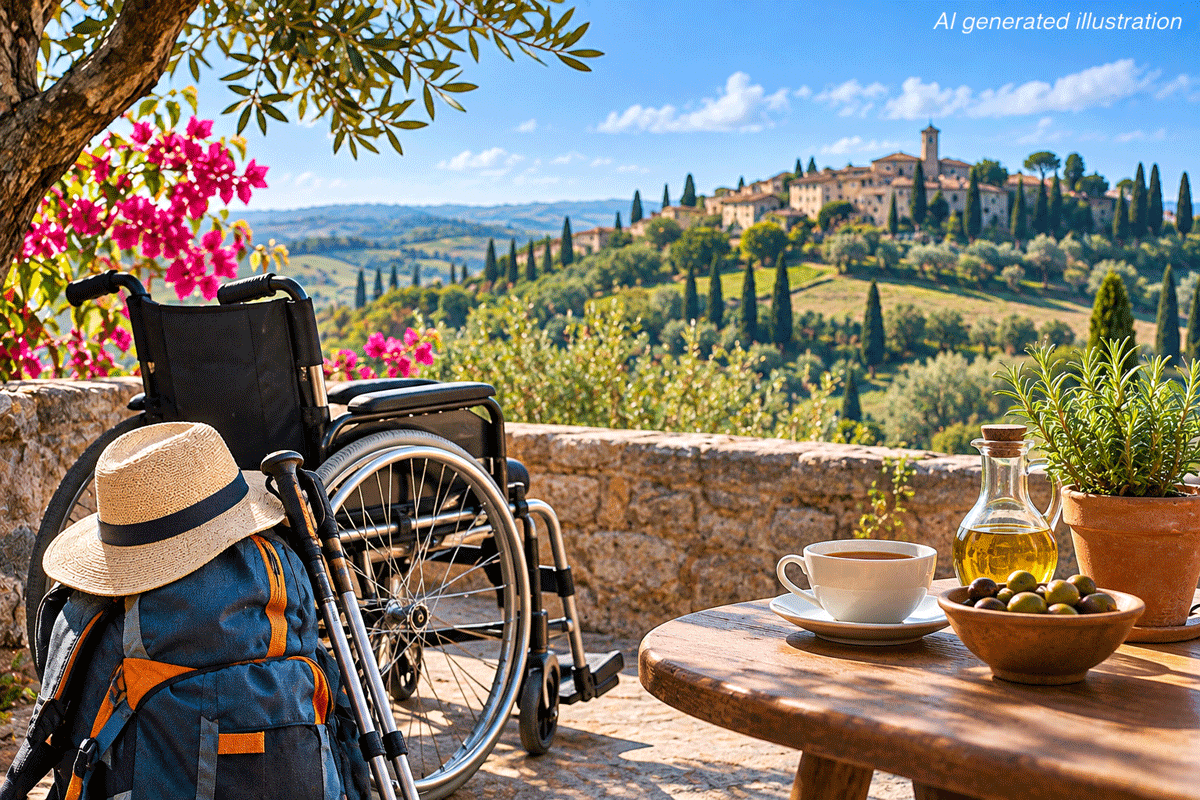
Italy offers a particularly interesting example of cooperation between patient organisations and the hospitality sector. Casa Vacanze I Girasoli, associated with the Italian Multiple Sclerosis Society (AISM), provides accessible holiday accommodation in the Tuscan countryside near Lucignano. The facility was developed around the requirements of people with mobility limitations, allowing guests to experience the region without many of the physical barriers encountered in conventional holiday accommodation.
On the Spanish island of Tenerife, the Mar y Sol hotel in Los Cristianos represents another specialised hospitality concept. Its origins are linked to the experience of its founder, whose wife had multiple sclerosis. The property combines adapted accommodation with accessible swimming pools, sports facilities and a therapy centre, demonstrating how recreational and therapeutic infrastructure can coexist within a holiday resort.
Denmark has developed a different approach through Dronningens Ferieby, an accessible holiday village near Grenaa. Its adapted holiday homes and provision of mobility equipment, including wheelchairs and lifting aids, can reduce the logistical burden on travellers and their accompanying family members.
These facilities illustrate how accessible tourism can extend beyond compliance with building regulations to encompass the entire holiday experience.
From Accessible Hotels to Accessible Journeys
Specialised travel operators are addressing another important challenge: ensuring accessibility throughout a journey rather than at the accommodation alone.
British travel company Responsible Travel reports experience in organising holidays for people with MS in destinations including Japan, Croatia, Norway, South Africa and the Galapagos Islands. Individually adapted itineraries can incorporate shorter excursions, additional rest periods and alternative activities according to travellers’ requirements.
In India, Enable Travel has developed accessible tourism services that include adapted transportation, travel assistance, mobility equipment and accessible sightseeing arrangements. Such services can help overcome barriers in destinations where accessibility standards vary considerably between hotels, transport providers and visitor attractions.
Patient organisations also play an important role. In the United Kingdom, the MS Society provides information about holiday opportunities and arrangements for people requiring additional care or assistance while travelling.
For many travellers, the availability of reliable support throughout a journey is just as important as the choice of destination itself.
Understanding the Specific Requirements of MS
Multiple sclerosis affects individuals in different ways. While some people can travel independently with relatively few adjustments, others require mobility equipment, personal assistance or access to healthcare services.
Fatigue is a particularly important consideration. Flexible itineraries, shorter distances between activities and opportunities to rest can make holidays more manageable. Accessible bathrooms, reliable transportation and suitable facilities for storing medication may also influence destination choice.
Temperature management presents another challenge. Some people with MS experience a temporary worsening of neurological symptoms when their body temperature rises, a response known as Uhthoff’s phenomenon. Air-conditioned accommodation, shaded outdoor areas and carefully selected travel seasons can therefore be important. Conventional wellness activities involving intense heat, such as saunas and hot thermal baths, may be unsuitable for heat-sensitive guests.
For tourism businesses, understanding these requirements offers an opportunity to develop services that benefit not only people with MS but also travellers living with other neurological conditions and chronic illnesses.
The development of specialised resorts and flexible travel services points towards a broader understanding of health-oriented tourism. Its value lies not only in providing access to treatment and rehabilitation, but also in enabling people with chronic conditions to participate in ordinary travel experiences.
For many people living with multiple sclerosis, the most meaningful achievement of accessible tourism is simply the freedom to travel for pleasure rather than medical necessity.
Image Credit: AI generated illustration