New spa concepts in Orlando and San Francisco are bringing together aquatic engineering, European thermal traditions and technology designed to make wellness outcomes more measurable
Thermal wellness is becoming a field for technological experimentation in the United States as developers combine traditional hot-and-cold bathing experiences with sophisticated aquatic engineering, digital technologies and preventive health concepts. Two projects now under development illustrate how the boundaries between spa design, health monitoring and research are beginning to converge.
Martin Aquatic, a Florida-based aquatic design and engineering company with experience from more than 3,500 projects worldwide, has launched Blue Mar Wellness as a specialist division for the thermal spa sector. Beyond designing commercial facilities, the company is developing its own hydrothermal destination in Orlando, which is intended to operate simultaneously as a wellness facility and a research and development environment.
Orlando facility to combine wellness and R&D
The planned Orlando facility is intended to provide a real-world environment in which new approaches to both the guest experience and spa operations can be developed and tested.
This reflects the increasing technical complexity behind contemporary thermal wellness. Modern facilities may combine saunas, steam rooms, hot and cold water experiences and relaxation areas, but the experience presented to guests depends on an extensive infrastructure operating behind the scenes.
Blue Mar's approach integrates mechanical, electrical, structural and chemical engineering with water treatment, controls and lighting. Instead of treating individual spa features as separate installations, the company approaches the facility as an interconnected aquatic system.
Digital planning also plays a role. Designs are developed with the mechanical, electrical, chemical and structural requirements coordinated before preassembled equipment and control systems are supplied. Resolving these interfaces during the planning stage is intended to reduce later modifications and technical problems.
San Francisco spa links hydrotherapy and body imaging
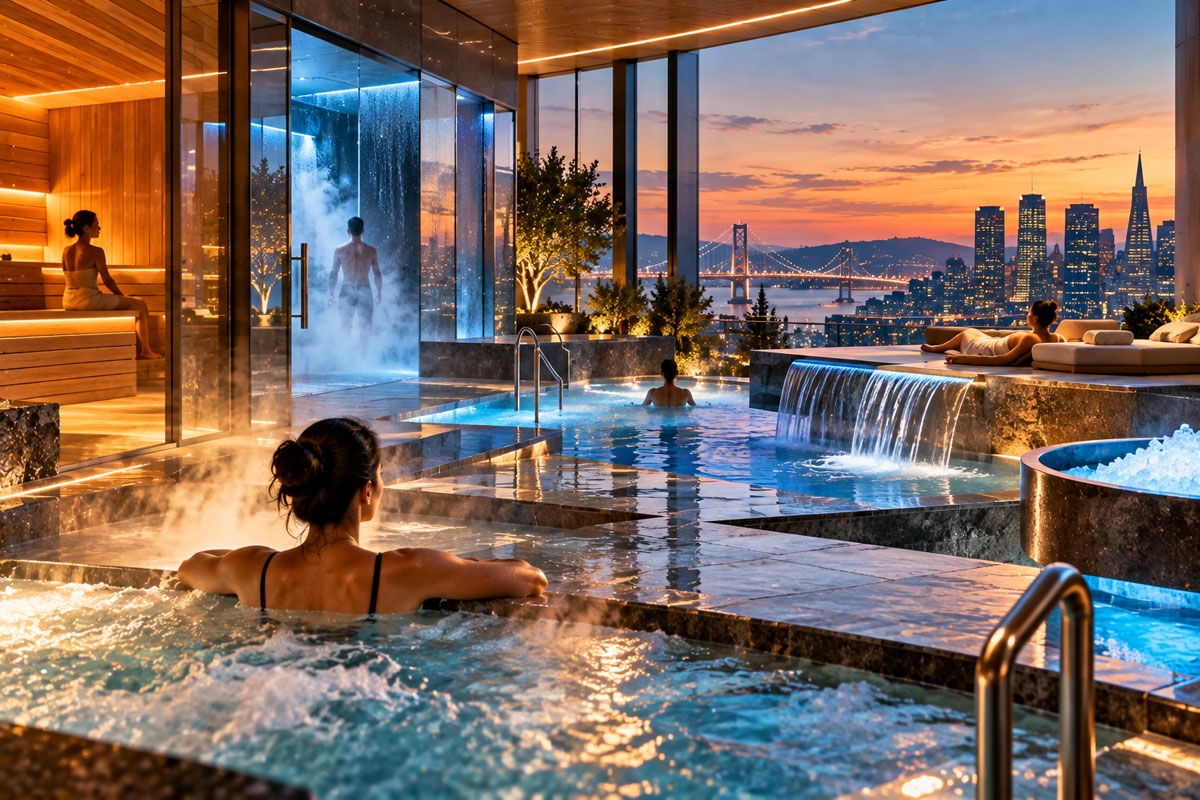
A second project takes the connection between wellness and technology further. Blue Mar Wellness is among the teams involved in the planned first Midjourney Spa near Union Square in San Francisco.
The approximately 2,100-square-metre facility is expected to combine traditional hydrotherapy and bathing rituals with body imaging technology. According to the project description, sound waves in water will be used to create detailed three-dimensional images of the body, allowing users to follow physical changes over time.
The concept is intended to establish a connection between preventive health, wellbeing and architecture, adding a measurable component to an experience traditionally associated primarily with relaxation.
Such concepts reflect a wider shift within the wellness sector towards personalisation and trackable outcomes. Thermal experiences are increasingly being considered alongside diagnostics, health data and preventive wellness rather than functioning solely as leisure amenities.
European thermal traditions provide inspiration
While the engineering and technology are being developed for the North American market, part of the inspiration comes from established European thermal culture.
US spas have traditionally concentrated heavily on individual treatments such as massages and facials. European and Scandinavian thermal facilities, by contrast, have a longer tradition of guests progressing through sequences of heat, cold and relaxation.
Martin Aquatic employees travelled to Germany and Italy to experience thermal destinations from the guest perspective while developing the Blue Mar concept. The European model has subsequently become an important reference for the company's approach to thermal wellness.
Introducing this type of experience to markets without the same bathing traditions also creates a design challenge. The architecture and layout must help guests understand how different thermal elements relate to one another rather than presenting a sauna, steam room or cold-water experience simply as an isolated amenity.
Technology designed to disappear
Despite the growing technical sophistication, the objective is not necessarily to make technology more visible. Instead, Blue Mar argues that engineering and control systems should largely disappear from the guest experience.
“The goal is not to highlight the technology,” said Matt Kent, vice president of business development at Martin Aquatic. “The goal is to make the technology invisible.”
The approach illustrates an emerging direction in thermal wellness innovation. Centuries-old bathing practices are not being displaced by technology but increasingly supported by engineering, digital controls and new forms of health monitoring.
Together, the Orlando R&D facility and the San Francisco project illustrate how traditional hydrothermal experiences are increasingly being combined with technologies aimed at greater personalisation, measurement and technical integration.
Image Credit: © AI generated illustration