
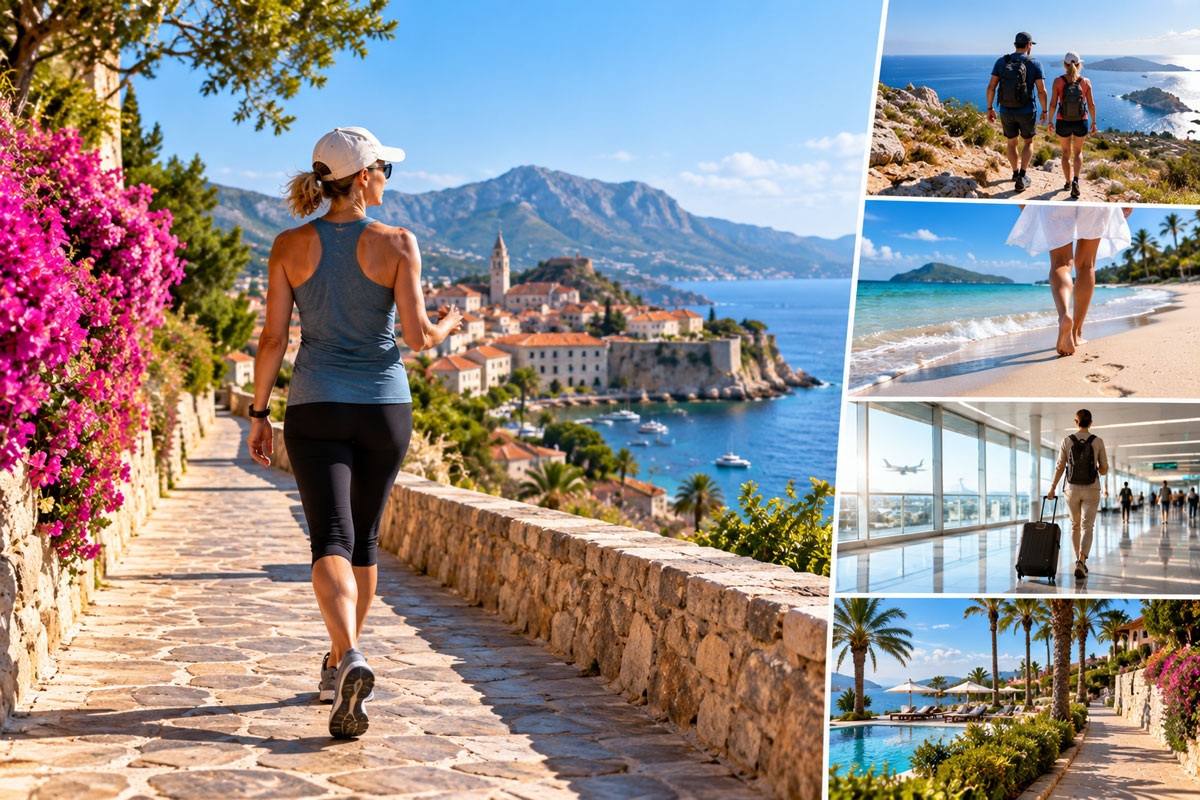
New research suggests that brisk walking can provide meaningful health benefits even at lower daily step counts – and travelling offers plenty of opportunities to make walking part of the day
Walking is already an integral part of many journeys, whether exploring a city, crossing an airport terminal, strolling along a beach or walking from a hotel to a restaurant. New research suggests that how quickly we walk may also matter, particularly for people who otherwise accumulate relatively few steps during the day.
A large study involving more than 100,000 middle-aged adults found that different combinations of daily step count and walking intensity were associated with lower risks of premature death. While higher overall step counts remained beneficial, faster walking appeared particularly relevant among people with comparatively sedentary lifestyles.
The findings offer an interesting perspective for healthy travel: adding physical activity to a holiday or business trip does not necessarily require a gym, organised exercise programme or an ambitious target of 10,000 steps every day.
Pace as well as distance may matter
Researchers analysed data from 103,684 participants in the UK Biobank who wore activity trackers for seven consecutive days between 2013 and 2015. They subsequently examined all-cause and cardiovascular mortality through 2022.
Participants were grouped according to their daily step counts and their walking intensity. Among people taking fewer than 5,000 steps a day, a higher stepping pace of at least 80 steps per minute was associated with a reduction in mortality risk comparable to that observed among people accumulating 5,000 to 7,500 steps at a lower pace.
Among participants taking fewer than 7,500 steps per day, maintaining a higher pace during their most active 30 minutes was associated with progressively lower mortality risk.
More steps still mattered. The lowest mortality risks were observed among people accumulating between 7,500 and 10,000 steps per day, irrespective of walking pace.
The research was observational and therefore cannot establish that walking faster or taking a particular number of steps directly causes a longer life.
Turn sightseeing into a healthy walk
For travellers, one practical advantage of walking is that it can become part of the journey itself rather than an additional activity that has to be scheduled.
City breaks provide perhaps the most obvious opportunity. Instead of using a taxi or public transport for every journey between attractions, travellers can select some routes that can comfortably be covered on foot. A walk through a historic district, along a waterfront or between museums can combine sightseeing and physical activity.
Those who already walk extensively while exploring a destination may accumulate substantial step counts without consciously exercising. Travellers covering shorter distances can instead consider introducing periods of more purposeful, brisk walking.
This does not mean rushing past the sights. A sightseeing day can alternate naturally between faster walking and slower periods for visiting attractions, taking photographs or stopping at cafés.
The 30-minute travel walk
For people spending much of their holiday sitting by a pool, travelling by car or relaxing at a resort, a dedicated walk can provide a simple way of introducing more movement into the day.
A brisk walk of around 30 minutes can fit naturally into many types of travel. It could be a morning exploration of the neighbourhood around the hotel, an evening walk before dinner, a circuit through a resort or a walk along a beach or promenade.
Business travellers can use the same principle. A walk before the first meeting, during a longer break or after the working day requires no fitness facilities and can be incorporated into an otherwise sedentary schedule.
The 30-minute period should not be interpreted as a guaranteed longevity formula. Rather, the new research suggests that maintaining a higher stepping pace during the most active half hour of the day may be particularly relevant for people whose overall daily step count is relatively low.
Airports and stations offer opportunities too
Travel days often involve long periods of sitting in cars, trains and aircraft. But airports and railway stations can also provide opportunities for walking.
Travellers with sufficient time before departure can walk through the terminal rather than remaining seated at the gate for the entire waiting period. When practical, stairs can replace escalators or lifts, and moving walkways do not always have to be the default option.
During longer connections, walking through the terminal can also break up prolonged periods of sitting before the next flight.
Comfort and safety should nevertheless come first. Travellers carrying heavy luggage, dealing with mobility limitations or facing tight connections should not turn an airport journey into an exercise challenge.
Beaches, resorts and wellness stays
Beach and resort holidays can sometimes produce surprisingly low daily step counts because restaurants, pools and accommodation are concentrated within a small area.
Here too, walking can become part of the holiday experience. Beach promenades, hotel gardens, parks and resort grounds can provide convenient routes, while some wellness hotels already incorporate guided walks, hiking or other forms of outdoor activity into their programmes.
Walking can therefore complement rather than compete with traditional wellness activities. A spa treatment or relaxation day does not have to mean spending the entire day inactive.
Travellers should nevertheless take local conditions into account. Extreme heat, humidity, altitude, uneven terrain and intense sun can make brisk walking more demanding than the same activity at home.
There is no need to chase a number all day
Perhaps the most useful message for travellers is that physical activity does not have to become another holiday target to be constantly monitored.
The familiar 10,000-step goal can be motivating, but the new research indicates that step count alone does not describe the whole picture. Walking intensity may contribute additional information, especially for people who find it difficult to accumulate large numbers of steps.
For healthy travel, that creates a flexible principle: walk when the journey naturally provides the opportunity, occasionally increase the pace when appropriate, and use the destination itself as the setting for physical activity.
A morning walk through an unfamiliar neighbourhood, a brisk stroll along a promenade or exploring part of a city on foot can provide something a hotel treadmill cannot: movement and travel experience at the same time.
Image Credit: © AI generated illustration