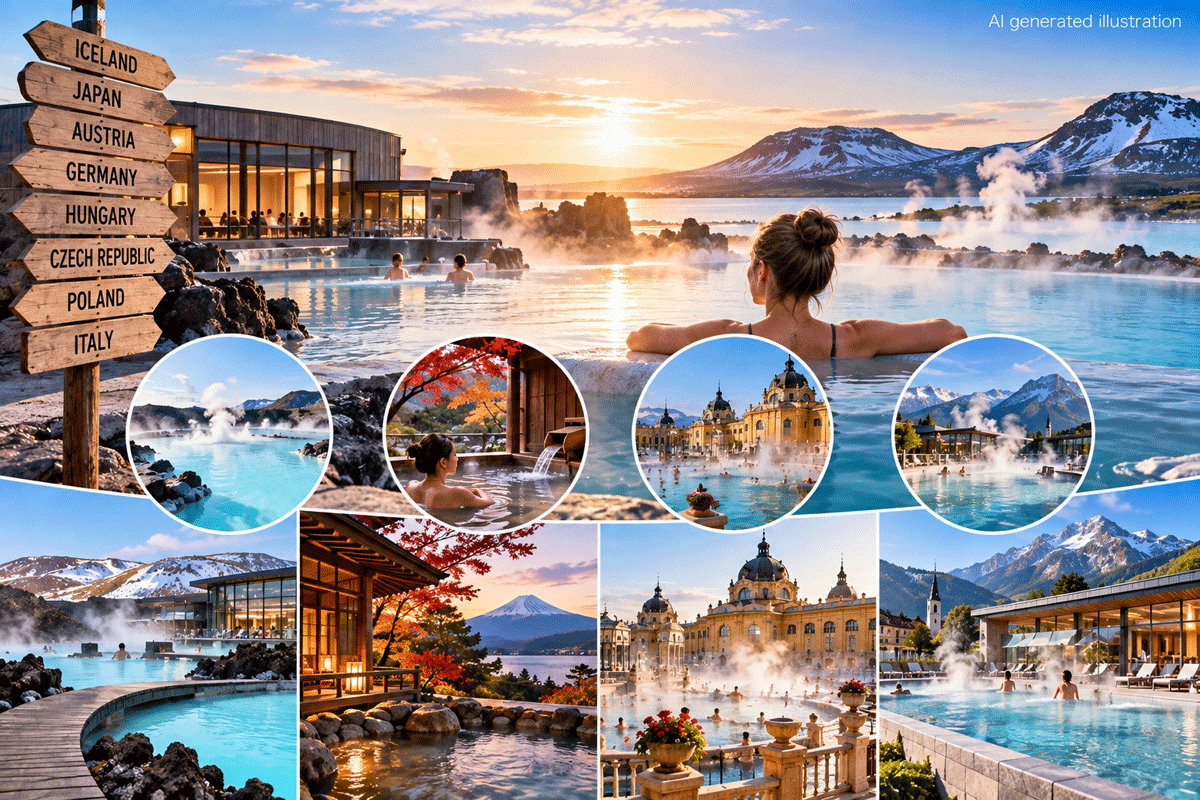
The industry generated nearly $72 billion in 2024, while hundreds of new thermal facilities are opening or under development across established and emerging wellness destinations
Thermal and mineral springs are attracting renewed investment worldwide as destinations seek to combine traditional bathing cultures with modern wellness tourism. According to research by the Global Wellness Institute (GWI), 365 new thermal and mineral springs projects opened between 2020 and 2025, with more than 250 additional developments in the pipeline. The expansion reflects growing commercial interest in experiences built around natural geothermal resources, relaxation and distinctive local traditions.
The global sector generated approximately $71.7 billion in revenue in 2024, an increase of 11.1 percent compared with the previous year. GWI estimates that 31,386 thermal and mineral springs establishments were operating across 130 countries. Although many remain traditional bathing facilities serving local communities, higher-end resorts are becoming increasingly important to the industry's commercial development.
For international health tourism, the expansion represents more than a revival of historic spa traditions. Thermal destinations are investing in accommodation, contemporary architecture, wellness programmes and visitor facilities to attract travellers seeking longer stays and experiences connected with nature. However, the growing commercial appeal of thermal bathing should be distinguished from clinical evidence supporting particular medical applications.
Iceland and Japan illustrate different expansion models
Iceland provides some of the clearest recent examples of investment in geothermal bathing as a tourism product. In northern Iceland, Earth Lagoon Mývatn opened an expanded geothermal spa in July 2026, replacing the original bathing complex with larger facilities. Designed by Basalt Architects, the project includes expanded lagoons, steam baths, visitor amenities and a restaurant integrated into the volcanic landscape around Lake Mývatn.
Another development, Reykjaböð Hot Springs near Hveragerði, announced the start of guest operations in September 2026. Its plans include a geothermal lagoon of approximately 900 square metres, saunas, cold pools and dedicated wellness facilities. Located near the Reykjadalur Valley, the development is intended to attract visitors travelling through southwestern Iceland as well as guests seeking a bathing experience close to Reykjavík.
These projects illustrate a business model in which natural geothermal resources are combined with architectural design and leisure facilities. The attraction is not primarily clinical treatment but an experience that can become a central component of a destination visit.
Japan is following a different path, building on its extensive onsen culture and established accommodation sector. In April 2026, Hoshino Resorts announced plans to expand its KAI hot spring ryokan brand to 30 properties by 2030.
The programme includes planned 2026 openings in Kusatsu, Miyajima and Zao, as well as a further property in Ureshino in 2027. The company is positioning regional bathing traditions and local cultural experiences as distinctive features of its accommodation portfolio.
For international travellers, such developments make thermal bathing accessible through structured hospitality products rather than requiring visitors to navigate traditional bathing establishments independently.
European spa destinations modernise established traditions
Europe remains one of the world's most important thermal tourism regions, with longstanding spa destinations in Germany, Austria, Hungary, Italy and the Czech Republic.
In Austria, Heilthermen Resort Bad Waltersdorf introduced a revised operating concept in October 2026, extending its adults-oriented positioning to the wider thermal resort for guests aged 14 and over. The development includes a new sauna designed for up to 60 people, part of an investment of approximately one million euros in its sauna facilities.
The project demonstrates how established spa operators are responding to demand for more specialised visitor experiences. Rather than relying solely on mineral water, resorts are investing in architecture, relaxation areas and differentiated accommodation concepts.
In Germany, Oberstdorf opened a newly built spa complex in January 2026, restoring a major bathing and wellness facility to the Alpine destination after the closure of its previous establishment in 2018. The development connects contemporary bathing facilities with the town's wider tourism infrastructure.
Central European spa towns are also investing in their traditional therapeutic facilities. In the Czech Republic, Lázně Darkov has been developing a modernised balneotherapy facility and new spa-related public infrastructure, reflecting the continuing importance of medical spa traditions alongside recreational wellness.
Further investment is planned in Poland. The Bachleda Termy Kasprowy geothermal complex in Zakopane is being developed on the site of the former bathing area at Polana Szymoszkowa. The planned facility covers more than 47,000 square metres and is expected to welcome its first guests by the end of 2028, according to the developer.
Medical applications require a different standard of evidence
The expansion of thermal tourism also raises questions about how destinations describe the health benefits of their facilities.
Traditional spa medicine includes balneotherapy, mineral-water bathing, mud applications and other treatments that may be used within supervised rehabilitation or physical medicine programmes. In some countries, such services are integrated into established healthcare systems and prescribed for selected conditions.
However, the evidence supporting individual interventions varies considerably. A relaxing geothermal lagoon, a recreational thermal pool and a medically supervised rehabilitation programme are not interchangeable services.
The distinction is particularly important as operators increasingly use terms associated with preventive medicine, longevity and recovery. Facilities offering medical treatment require appropriate clinical expertise and professional oversight, while recreational bathing businesses should avoid presenting general relaxation benefits as proof of disease-specific effectiveness.
The Global Wellness Institute's market definition also requires careful interpretation. Its thermal and mineral springs revenue figures include accommodation, food and beverage, recreational activities and other services provided by qualifying establishments. The reported $71.7 billion therefore represents a broad commercial sector rather than expenditure exclusively on therapeutic bathing.
For destinations, the investment trend creates opportunities extending beyond admission revenue. Thermal attractions can support hotels, restaurants, transport services and longer visitor stays, while helping established spa towns remain competitive with newer wellness resorts.
The sector's development is increasingly shaped by two complementary approaches: modernising historic spa traditions and creating contemporary bathing destinations around natural geothermal resources. Both can strengthen international wellness tourism, provided that the distinction between leisure experiences and medically supported treatment remains clear.
Image Credit: AI generated illustration