International dental tourism offers potential savings, but treatment complexity, travel expenses and long-term aftercare determine the real value of treatment abroad
International dental tourism continues to attract patients seeking more affordable implant treatment, with Turkey, Mexico, Thailand and several Latin American countries competing for overseas demand. Differences in treatment prices can be substantial, particularly when compared with private dental care in the United States. However, advertised prices provide only a partial picture of the financial and medical considerations involved in travelling abroad for dental treatment.
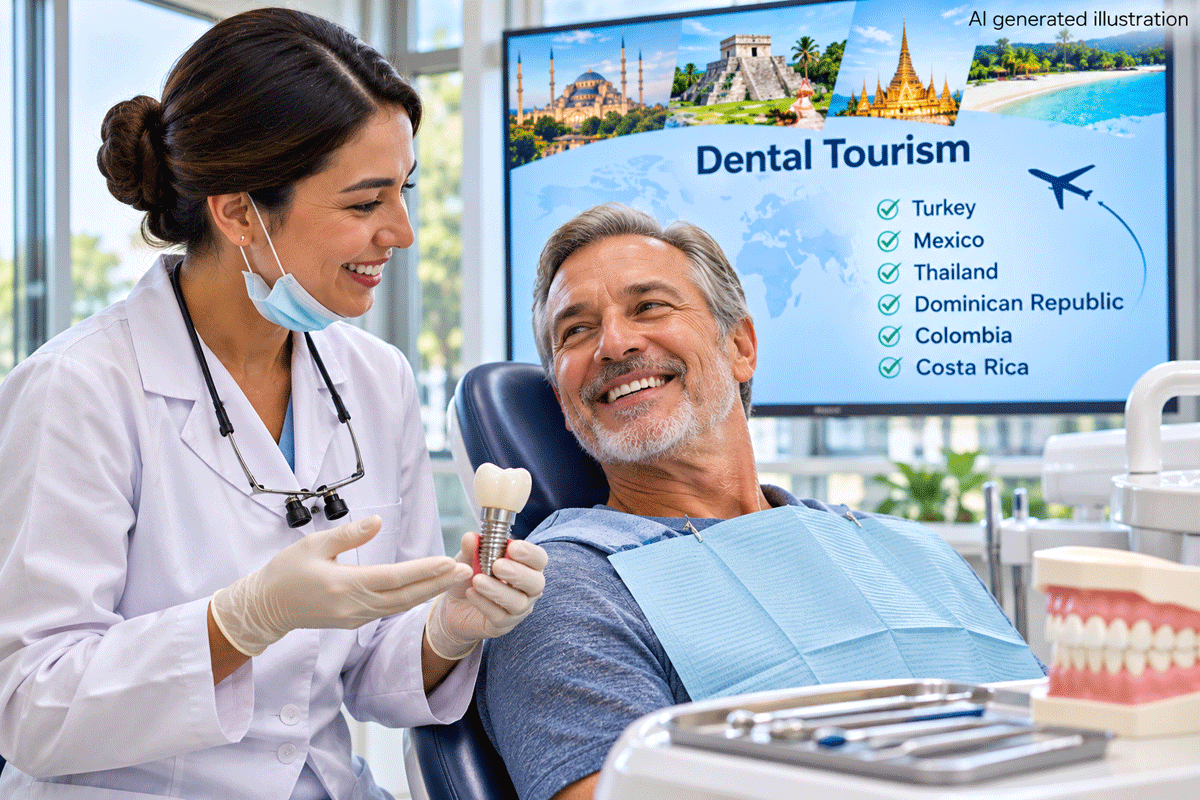
A comparison of publicly advertised offers on the medical travel platform Bookimed illustrates the wide variation between international dental tourism markets. Turkey features some of the lowest advertised starting prices, while Mexico benefits from its proximity to the United States. Thailand, Colombia, Costa Rica and the Dominican Republic offer further alternatives, combining dental services with established tourism infrastructure. These comparisons are based on commercial listings rather than independently established national price averages.
For patients, the decisive question is not simply where an implant costs the least. The overall expense depends on the clinical condition, the materials used, the number of appointments and the services included in the treatment plan. Travel, accommodation and possible return visits can considerably alter the financial calculation. Equally important are the qualifications of the treating dentist, infection-control standards and arrangements for managing complications after the patient returns home.
Turkey and Mexico follow different competitive models
Turkey has established a prominent position in international dental tourism, particularly through private clinics in Istanbul and Antalya. Its appeal rests on a combination of comparatively low advertised treatment prices, international flight connections and an extensive hospitality sector.
Commercial listings on Bookimed include individual dental implant offers starting at several hundred US dollars, although the precise amount depends on the provider and the components included. These figures should not be interpreted as representative prices for the Turkish dental market as a whole.
Some clinics offer packages combining treatment with airport transfers, accommodation or assistance with travel arrangements. Such services may simplify the organisation of a medical trip, but patients still need a detailed breakdown of the clinical procedures covered.
Mexico competes through a different geographical advantage. Dental tourism centres such as Los Algodones and Tijuana attract patients from the United States, particularly from nearby states where travelling across the border can be considerably easier than undertaking a long-haul journey.
Cancún also participates in the international dental market, combining private healthcare services with a major tourism destination.
For patients requiring several appointments, proximity can be particularly valuable. The possibility of returning to the same clinic without extensive international travel may reduce some of the logistical difficulties associated with dental treatment abroad.
Nevertheless, treatment costs vary considerably between Mexican providers, and geographical convenience does not eliminate the need to assess clinical quality, professional qualifications and aftercare arrangements.
Thailand represents another established market, with Bangkok and Chiang Mai offering private dental services to international patients. The country's wider medical tourism industry provides an infrastructure of hospitals, specialist clinics, hotels and travel services that can support longer treatment stays.
However, the financial advantages of treatment in Thailand depend partly on the patient's country of residence. For travellers from North America or Europe, long-distance flights and extended accommodation requirements may offset part of the difference in clinical fees.
Latin America offers further dental tourism alternatives
Beyond Mexico, several Latin American and Caribbean destinations participate in the international dental tourism market.
Costa Rica has developed an international patient market centred particularly on San José. Its private dental sector serves overseas patients seeking implant treatment, restorative dentistry and other procedures.
Colombia offers dental services in major urban centres such as Bogotá and Medellín, while the Dominican Republic has an established private dental market in Santo Domingo and other locations.
These destinations illustrate how dental tourism has become part of a broader international healthcare economy. Their competitive positions depend on different combinations of clinical services, travel accessibility, treatment prices and established tourism infrastructure.
However, comparing countries solely through advertised starting prices can be misleading.
An individual implant quotation may refer only to the titanium implant inserted into the jawbone. Other offers include the abutment and permanent crown, while additional procedures may be charged separately.
The same problem arises with full-arch restorations commonly marketed as All-on-4 treatment. The final cost can depend on the number and type of implants, the materials used for the prosthesis, the need for extractions and the distinction between temporary and permanent restorations.
Consequently, two apparently similar treatment packages may involve substantially different clinical procedures and financial commitments.
Commercial comparison platforms can provide an initial overview of available offers, but their listings represent participating providers rather than a comprehensive or independently verified picture of national dental markets.
Long-term aftercare becomes a decisive factor
Dental implants differ from many other elective medical tourism procedures because treatment may extend over several months.
Following implant placement, a healing period is often necessary to allow the implant to integrate with the surrounding bone. The duration varies according to individual clinical circumstances, including bone quality, the location of the implant and the patient's general health.
In selected cases, immediate loading or accelerated restoration techniques may be possible. However, these approaches are not suitable for every patient and should not be presented as universally available alternatives to conventional treatment.
International patients therefore need an individual treatment schedule before making travel arrangements.
Some procedures may be completed during a single extended stay, while others require separate appointments for implant placement and the final restoration. Additional visits may become necessary if complications occur or treatment plans change.
Postoperative care is equally important. Infection, implant failure, problems with the prosthetic restoration or other complications may require further professional attention.
Patients should establish whether a qualified dentist in their home country can provide follow-up care and whether the overseas clinic will supply complete treatment records, implant specifications and relevant diagnostic information.
Clear arrangements are particularly important when different practitioners are responsible for the surgical and prosthetic stages of treatment.
Professional licensing, recognised quality standards and documented infection-control procedures can help patients evaluate potential providers. However, neither international accreditation nor the reputation of a destination guarantees an individual treatment outcome.
Transparent pricing should also extend beyond the initial procedure. Patients need to understand the possible costs of additional diagnostics, bone grafting, temporary restorations, medication, complications and subsequent adjustments.
For the international dental tourism industry, these considerations increasingly distinguish comprehensive patient care from the promotion of inexpensive procedures.
Turkey's competitive prices, Mexico's geographical accessibility and the established healthcare tourism infrastructure of Asian and Latin American destinations offer different advantages to different patient groups.
The most sustainable competitive position may ultimately belong to providers that combine appropriate treatment costs with reliable clinical standards, realistic scheduling and accessible long-term follow-up care.
For patients considering dental treatment abroad, the true value of an international offer is determined not by the lowest advertised implant price, but by the quality, completeness and continuity of the treatment received.
Image Credit: AI generated illustration