
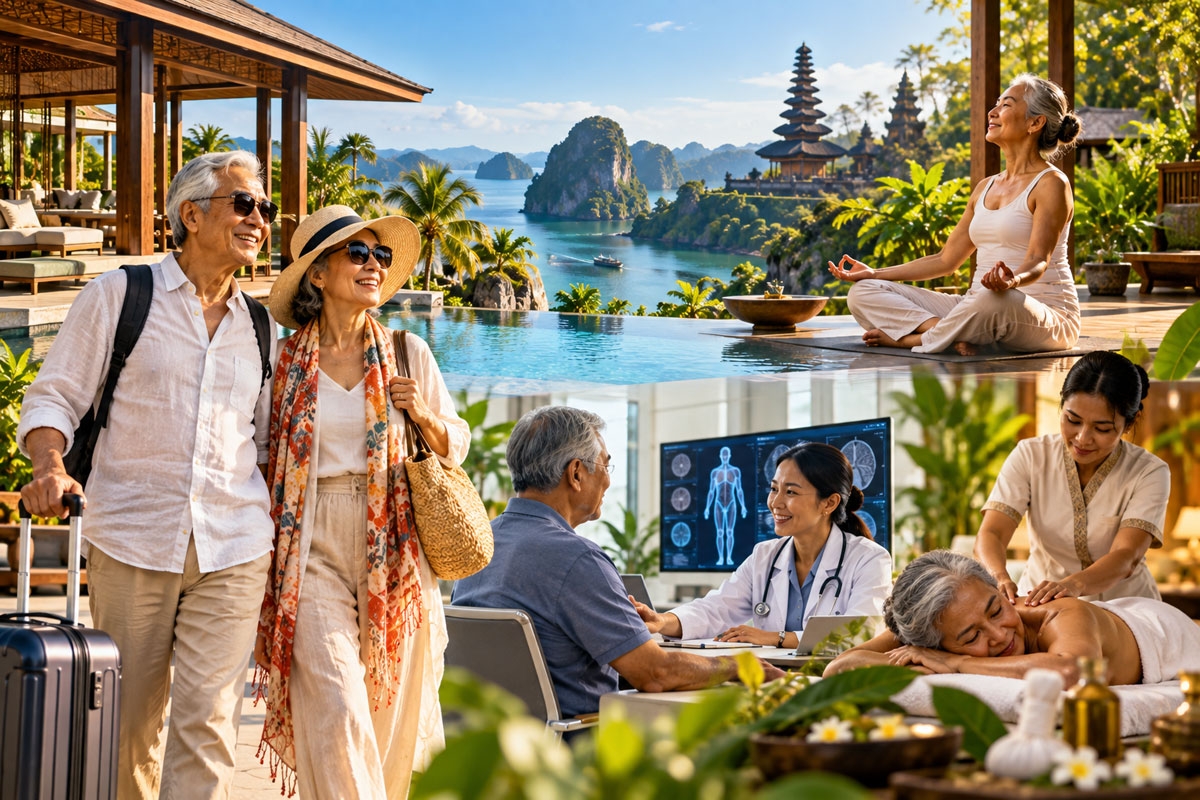
Healthcare and tourism are expected to become the two leading spending sectors as Asia-Pacific’s over-60 population accumulates $7.1 trillion in savings by 2030
Asia-Pacific's rapidly ageing population is creating a major new market for healthcare, wellness and travel. By 2030, an estimated 733 million people aged 60 and above will live across 14 markets in the region, collectively holding around $7.1 trillion in savings.
Healthcare and travel and tourism are expected to become the two leading spending sectors among this population, according to the fifth edition of the Asia Pacific Silver Economy Business Opportunities 2026-2030: Building the Longevity Ecosystem report, released by industry alliance Ageing Asia in collaboration with Singapore Management University.
The findings point to an opportunity extending well beyond traditional elderly care. In particular, consumers between 60 and 75 represent an increasingly important market for travel, wellness, preventive healthcare and longevity services.
“How long we live and how long we live well is at once the region’s largest humanitarian challenge and its largest commercial opportunity,” Ageing Asia founder and report lead author Janice Chia said.
From care economy to consumer economy
The report distinguishes between two increasingly different markets within the silver economy.
The established “care economy” encompasses healthcare, home care, assisted living and dementia services and primarily serves people aged 75 and above.
A second market is developing among younger seniors. The report describes this as the “consumer economy”, covering travel, wellness, lifestyle services, experiences and silver tourism.
People between 60 and 75 often remain healthy and active while having both disposable income and time available for travel. This makes them a particularly relevant target group for destinations and providers combining healthcare with tourism.
Preventive medical examinations, longevity programmes, rehabilitation, medical wellness, spa and thermal treatments and other health-oriented services can increasingly become part of the travel experience rather than being associated solely with illness and treatment.
Healthcare and travel lead future spending
The scale of the demographic shift makes this particularly significant for the health tourism industry.
With 733 million people aged 60 and above across the markets examined by the report, even relatively small changes in consumer behaviour could generate substantial demand for health-related travel products.
The findings also suggest that traditional boundaries between healthcare providers, wellness operators and hospitality companies are becoming less relevant.
An active 65-year-old consumer might combine a holiday with comprehensive diagnostics, preventive treatment, nutrition programmes or a wellness retreat. As that same customer ages, healthcare and support requirements can gradually become more important.
Companies capable of accompanying consumers through different stages of ageing could therefore develop relationships lasting considerably longer than those based on individual treatments or holidays.
Industry sees strong growth but insufficient supply
The report includes a survey of 110 industry leaders from 15 countries and territories, including clinicians, academics, operators, inventors and policymakers.
Confidence in the market is high. Around 85 percent of respondents expect either strong or steady growth in the Asia-Pacific silver economy between 2026 and 2030.
Existing services, however, received an average adequacy rating of only 2.8 out of five.
The contrast between strong expectations for demand and relatively low satisfaction with current supply points to considerable room for new healthcare, wellness and tourism concepts.
According to the report, closing this gap will require investment in infrastructure, workforce development, financing and new operating models.
Integrated health and lifestyle models gain importance
The study argues that future opportunities will increasingly favour integrated ecosystems rather than providers concentrating on a single service.
Housing, healthcare, community, wellness and economic participation can form parts of the same ageing ecosystem. For the travel industry, a similar principle could encourage closer cooperation between hotels, resorts, hospitals, specialist clinics, wellness providers and preventive medicine centres.
This development is already visible in the growing international market for longevity and medical wellness, where conventional hospitality is increasingly combined with diagnostics, personalized health programmes and medically supervised interventions.
The Asia-Pacific region offers particularly favourable conditions for such models because it combines rapidly ageing populations with established medical tourism destinations and a sophisticated hospitality industry.
Different markets offer different opportunities
The report identifies Singapore, Japan, Hong Kong, Australia and New Zealand as markets with mature operators, substantial capital and business models that could potentially be exported elsewhere.
South Korea and Taiwan offer different opportunities, particularly through technologies such as care robotics, wearables, smart-home sensors and digital health equipment.
Other destinations across Asia could benefit as consumers increasingly travel in search of healthcare, prevention and wellness services.
This creates opportunities not only within individual domestic markets but also for international destinations seeking to attract affluent and health-conscious Asian travellers.
Longevity becomes a travel market
For the health tourism industry, the demographic shift changes the traditional concept of senior travel.
The emerging 60-to-75 market is not defined primarily by dependency or care. Many consumers in this group are seeking ways to remain healthy, active and independent for longer.
That makes longevity itself increasingly relevant to tourism.
Destinations able to combine medical expertise, preventive healthcare, wellness, hospitality and attractive travel experiences could be particularly well positioned to capture part of this growing demand.
With hundreds of millions of ageing consumers and trillions of dollars in accumulated savings, Asia-Pacific's silver economy could therefore become one of the most important long-term source markets for international health and wellness tourism.
Image Credit: © AI generated illustration