
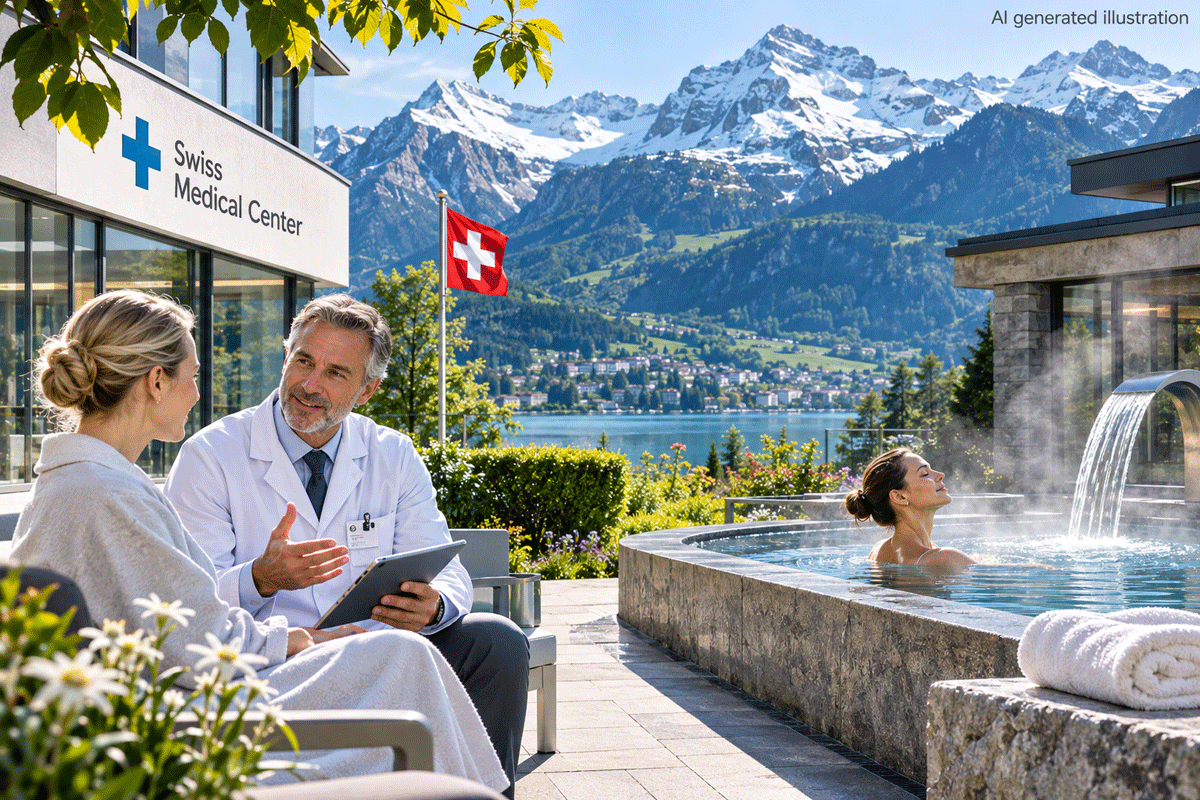
World-class specialist hospitals, advanced rehabilitation centres and a centuries-old spa tradition position Switzerland as a destination for complex medical treatment, preventive healthcare and restorative travel
Switzerland occupies a distinctive position in international health tourism. Rather than competing on treatment prices, the country attracts patients seeking specialised medical expertise, sophisticated diagnostic technologies, high standards of clinical care and personalised services. Its healthcare system combines internationally recognised university hospitals, private medical institutions and specialist rehabilitation centres with a longstanding tradition of Alpine health resorts and thermal spas.
The country's appeal extends across several segments of international healthcare. Patients travel to Switzerland for complex surgery, oncology, cardiovascular medicine, orthopaedics, neurological treatment and rehabilitation. Private clinics also serve international demand for preventive health assessments, executive medical examinations and selected longevity programmes. At the same time, Switzerland's mountain landscapes, mineral springs and established hospitality industry provide a setting for wellness tourism that differs considerably from conventional hospital-based medical travel.
Geographical accessibility is another advantage. Zurich and Geneva provide international air connections, while Switzerland's rail and road networks facilitate transfers between airports, medical centres and resort destinations. The country's multilingual environment supports patients from different regions, with German, French, Italian and English used across much of the international healthcare sector. However, high treatment and accommodation costs, insurance restrictions and the availability of specialist capacity remain important considerations for patients planning care abroad.
University hospitals and internationally recognised private clinics
Switzerland's medical reputation rests partly on its network of university hospitals, which combine specialist treatment with medical education and research.
University Hospital Zurich is a major centre for complex medicine, offering services in oncology, cardiovascular care, transplantation, neurology and other highly specialised disciplines. Its connections with the University of Zurich and the wider biomedical research environment contribute to the development of advanced diagnostic and therapeutic approaches.
Geneva University Hospitals, known as HUG, represent another important institution, with extensive specialist services and close academic links to the University of Geneva. Lausanne University Hospital, or CHUV, is similarly recognised for its clinical research and specialist treatment capabilities.
The university hospitals in Basel and Bern, including Inselspital, complete a network that plays a central role in Switzerland's tertiary healthcare system.
These institutions provide advanced medical services, although access for international patients depends on clinical indications, capacity, referral arrangements and financial conditions. Not every highly specialised procedure is available to overseas patients on a routine commercial basis.
Switzerland also has a substantial private healthcare sector serving both domestic and international patients.
Hirslanden, part of the Mediclinic group, operates hospitals and medical centres across the country. Its network includes institutions in Zurich, Geneva and other major locations, offering services ranging from orthopaedic surgery and cardiology to oncology and specialist diagnostics.
Swiss Medical Network is another significant private hospital group, with clinics operating in different linguistic regions. Its facilities provide a range of surgical, medical and rehabilitation services.
In western Switzerland, Clinique de Genolier has an established profile in specialist medicine, particularly oncology and surgery. Geneva's private healthcare market includes institutions such as Clinique La Colline and Hôpital de La Tour, both serving patients requiring specialist consultations and treatment.
International patient departments and multilingual coordination services can assist with medical appointments, treatment estimates, accommodation and administrative requirements.
Nevertheless, patients should distinguish between the reputation of a hospital group and the qualifications, experience and clinical outcomes of the individual specialists responsible for their treatment.
Complex medicine, advanced diagnostics and rehabilitation
Switzerland's international medical tourism sector is particularly relevant for patients seeking specialised treatment rather than routine low-cost procedures.
Oncology represents an important area of expertise. University hospitals and selected private institutions provide multidisciplinary cancer care involving surgery, systemic therapies, radiation oncology, advanced imaging and molecular diagnostics.
The availability of targeted treatments, immunotherapies and precision diagnostic methods reflects Switzerland's broader strengths in biomedical research and pharmaceutical development.
However, the suitability of individual treatments depends on the patient's diagnosis, disease stage and medical history. Access to innovative therapies does not necessarily imply superior outcomes, and experimental approaches should be distinguished from established clinical care.
Cardiovascular medicine is another major specialisation. Swiss hospitals provide interventional cardiology, cardiac surgery, electrophysiology and treatment for complex vascular conditions.
Orthopaedic surgery and sports medicine also contribute to international demand, particularly for joint replacement, spinal disorders and the treatment of musculoskeletal injuries.
Switzerland's reputation in neurological medicine is supported by specialist services in neurosurgery, stroke care, neurorehabilitation and the management of complex neurological conditions.
Its research environment creates additional opportunities for cooperation between hospitals, universities and medical technology companies.
The presence of internationally active pharmaceutical and life sciences companies, particularly around Basel, reinforces the country's position within the global healthcare industry. Roche and Novartis are headquartered in the region, while other Swiss research centres contribute to medical technology, biotechnology and diagnostic innovation.
These connections support the wider medical ecosystem, although pharmaceutical research activity should not be confused with the availability of particular treatments to international patients.
Rehabilitation is an especially important component of Switzerland's health tourism offering.
The country has developed specialist facilities for neurological, orthopaedic, cardiovascular and pulmonary rehabilitation, as well as programmes supporting recovery after serious illness or surgery.
Institutions such as the Swiss Paraplegic Centre in Nottwil provide highly specialised rehabilitation services, particularly for people with spinal cord injuries.
Other rehabilitation providers operate in Alpine and lakeside environments, combining clinical services with settings that may support rest, mobility training and longer recovery stays.
For international patients, rehabilitation can require substantially more time than an acute hospital procedure. Treatment plans must therefore account for accommodation, therapy intensity, medical supervision and arrangements for continuing care after returning home.
Alpine health resorts and thermal wellness traditions
Switzerland's position in health tourism extends well beyond modern hospitals.
The country's spa and health resort traditions developed around mineral springs, mountain climates and the belief that natural environments could support recovery and wellbeing.
Several destinations retain an international reputation for thermal bathing and wellness travel.
Bad Ragaz is among the country's best-known health resorts. Its thermal bathing tradition is associated with the warm waters of the nearby Tamina Gorge, while Grand Resort Bad Ragaz combines luxury hospitality, wellness facilities and medical services.
The destination illustrates Switzerland's ability to connect preventive healthcare and specialist medical offerings with a high-end resort environment.
Leukerbad, in the canton of Valais, is another established thermal destination. Its mineral-rich waters and mountain setting attract visitors seeking bathing, relaxation and outdoor activities.
Baden has a thermal bathing history extending back to Roman times. The modern Fortyseven thermal spa has contributed to the redevelopment of the town's historic bathing district.
In western Switzerland, Yverdon-les-Bains combines thermal bathing with a lakeside setting, while other destinations offer wellness experiences built around Alpine landscapes, hotels and outdoor recreation.
The country's mountain resorts also provide opportunities for activity-based wellness travel, including hiking, guided exercise, relaxation programmes and nature-oriented retreats.
However, the distinction between therapeutic medicine and general wellness remains essential. Thermal bathing may offer relaxation and symptom relief for selected conditions, but the medical effectiveness of individual treatments depends on the available evidence and the patient's health status.
Natural surroundings alone do not constitute a substitute for appropriate medical treatment.
Preventive medicine and the longevity market
Switzerland's premium healthcare environment has encouraged the development of preventive medicine and personalised health services aimed at international clients.
Private hospitals and specialist clinics offer comprehensive health assessments that may include cardiovascular evaluation, metabolic testing, diagnostic imaging and consultations with medical specialists.
Some providers have expanded into programmes marketed around longevity, healthy ageing, nutrition, physical performance and lifestyle management.
The country has also attracted international attention through luxury medical wellness concepts that combine accommodation with clinical assessments and personalised programmes.
Clinique La Prairie in Montreux is one of the best-known examples of this market. The institution has developed a reputation for premium longevity-oriented services, combining medical assessments with wellness, nutrition and lifestyle programmes.
Such offerings reflect growing international demand for preventive healthcare among affluent travellers.
Nevertheless, the term longevity encompasses a wide range of approaches with different levels of scientific support.
Established preventive measures, including cardiovascular risk management, appropriate physical activity and evidence-based screening, should be distinguished from experimental interventions or commercial programmes whose claims of extending human lifespan have not been demonstrated.
Extensive medical testing can also produce incidental findings, unnecessary follow-up investigations and additional costs. International patients should therefore seek an individual assessment of the potential benefits and limitations of proposed screening programmes.
For Switzerland, the opportunity lies in connecting credible medical expertise with high-quality hospitality and personalised service, without allowing commercial longevity claims to exceed the available clinical evidence.
International patients, regulation and premium treatment costs
Switzerland's international healthcare market is shaped by its proximity to major European economies, its global financial and business connections and the reputation of its medical institutions.
Private hospitals attract patients from neighbouring European countries and more distant markets, including the Middle East and other regions where demand exists for specialist treatment and premium healthcare services.
However, the country's role in international medical tourism is not directly comparable with destinations that depend on large volumes of overseas patients seeking inexpensive elective procedures.
Swiss treatment costs are generally high by international standards. Hospital charges, specialist fees, diagnostic procedures and accommodation can make treatment considerably more expensive than in competing destinations in Europe or Asia.
For some patients, the appeal lies in access to particular specialists, complex multidisciplinary care or services that may not be readily available in their home healthcare systems.
International patients should obtain detailed estimates before treatment and clarify the financial consequences of complications, prolonged hospitalisation or additional procedures.
Insurance arrangements require particular attention. Coverage depends on the patient's country of residence, insurance policy, treatment type and applicable cross-border healthcare rules.
European patients may have certain rights concerning medically necessary treatment during temporary stays, but these arrangements should not be confused with unrestricted reimbursement for planned private treatment abroad.
Switzerland's healthcare system is regulated through a combination of federal and cantonal responsibilities. Swissmedic oversees therapeutic products, while professional licensing, hospital authorisation and healthcare supervision involve the relevant authorities.
International accreditations may provide additional information about individual institutions, but they should not be treated as universal indicators of clinical performance. Patients should verify current certifications and assess the specific services and professionals involved.
The country also faces domestic healthcare challenges, including rising expenditure, workforce pressures and the need to maintain access to care for residents.
These factors may influence the capacity available for international patients, particularly in highly specialised public institutions.
Switzerland's future position in health tourism is therefore likely to depend on a combination of medical specialisation, research-driven innovation, rehabilitation expertise and premium wellness services.
Its hospitals and clinics are unlikely to compete primarily through lower prices. Instead, their international appeal rests on advanced clinical capabilities, personalised care, established regulatory structures and connections to one of Europe's most developed life sciences environments.
At the same time, Alpine rehabilitation centres, thermal destinations and luxury medical wellness providers give Switzerland a broader health tourism identity than hospital treatment alone.
The country's distinctive strength lies in bringing these different sectors together while maintaining clear boundaries between evidence-based medicine, preventive healthcare and recreational wellness.
For international patients and health-conscious travellers, Switzerland offers a premium healthcare environment in which specialist medicine, rehabilitation and restorative travel can complement one another. Its continued success will depend on clinical quality, transparent costs and the ability to translate scientific expertise into services that deliver meaningful benefits for patients.
Image Credit: AI generated illustration