From Swiss medical retreats to Mediterranean wellness resorts and Thai integrative health programmes, five destinations illustrate how longevity tourism is evolving beyond traditional spa holidays
Longevity has become one of the most prominent themes in international health and wellness tourism. Increasingly, travellers are seeking holidays that combine relaxation with medical assessments, personalised nutrition, physical activity and strategies intended to support healthy ageing. Luxury resorts and specialist clinics are responding with programmes that bring preventive medicine and hospitality together, often in destinations already known for their natural surroundings and established wellness traditions.
The emerging market is diverse. Some providers focus on advanced diagnostics and physician-supervised programmes, while others combine exercise, stress management, sleep improvement and nutrition with spa treatments. The common objective is to help guests maintain their health and functional abilities as they grow older. However, the term longevity covers a wide range of services, and not every intervention marketed under this label has demonstrated an ability to extend human life.
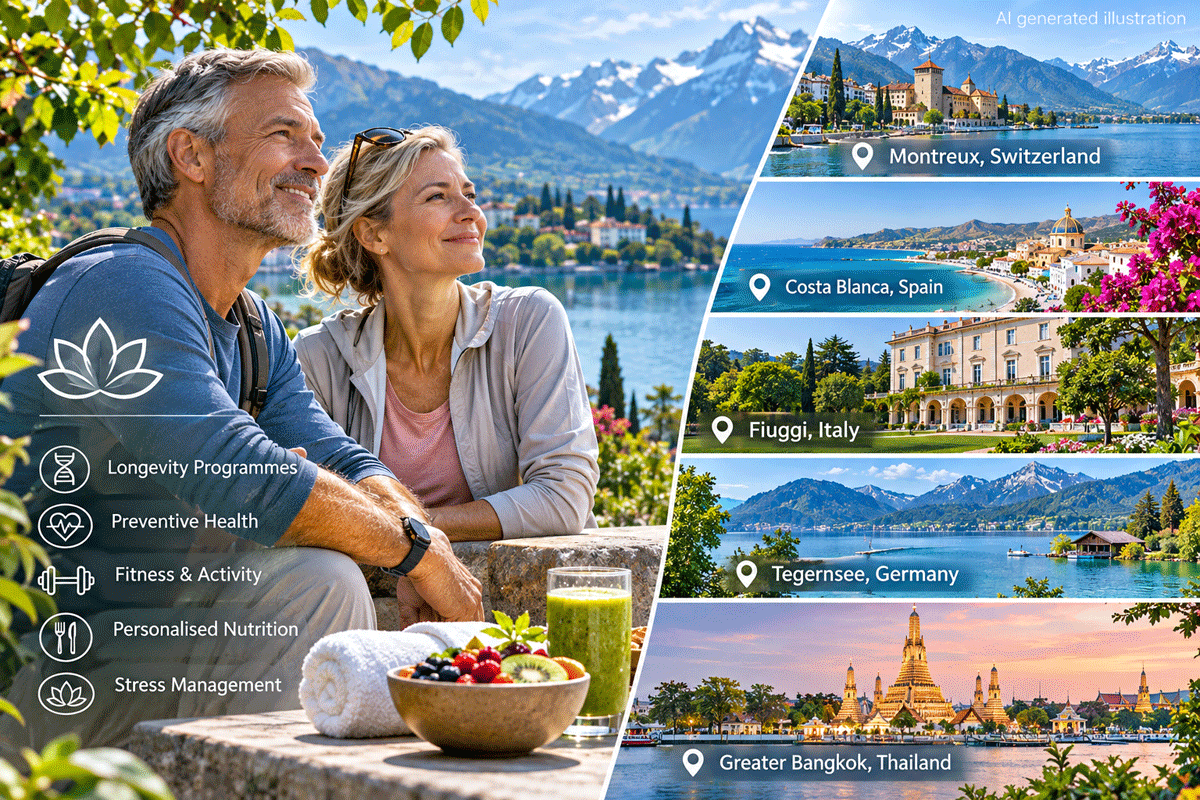
Five destinations stand out for their combination of established healthcare or wellness infrastructure, dedicated programmes and international accessibility: Montreux in Switzerland, the Costa Blanca in Spain, Fiuggi in Italy, the Tegernsee region in Germany and Greater Bangkok in Thailand. The selection reflects the breadth of available experiences rather than a scientifically established ranking of treatment effectiveness.
Montreux, Switzerland: Medical longevity on Lake Geneva
Montreux has become an internationally recognised destination for medically oriented longevity retreats, largely through the presence of Clinique La Prairie. Established in 1931, the institution combines luxury accommodation with medical assessments, preventive healthcare and specialised wellness programmes overlooking Lake Geneva.
Its portfolio includes Revitalisation, Master Detox, Healthy Weight, Brain Potential and comprehensive health diagnostics. The programmes involve medical specialists and may incorporate laboratory testing, cardiovascular assessment, nutritional consultations and personalised lifestyle recommendations.
The clinic occupies the premium end of the international longevity market. Its published seven-day Revitalisation programme starts at CHF 31,800, including accommodation, while the three-day Health Diagnostic programme starts at CHF 17,680. These prices underline the exclusive positioning of a destination where medical services and high-end hospitality are closely integrated.
For international guests, Montreux offers convenient access through Geneva Airport and a setting that supports outdoor activity, relaxation and recovery. However, individual interventions marketed as cellular rejuvenation or biological age optimisation require careful assessment of their clinical evidence.
Costa Blanca, Spain: Longevity in a Mediterranean setting
Spain’s Costa Blanca has established a prominent position in medical wellness through SHA Wellness Clinic, located near Altea on the Mediterranean coast.
The resort combines medical consultations, diagnostic services, personalised nutrition and physical activity with the traditional attractions of a Mediterranean holiday. Its programmes address different priorities, including weight management, stress, metabolic health and longevity.
SHA’s Advanced Longevity programme focuses on individual health assessments and interventions selected according to the guest’s medical profile. The operator also offers programmes centred on energy, emotional wellbeing and lifestyle improvement.
The destination benefits from the Costa Blanca’s mild climate, coastal landscapes and accessibility through Alicante Airport. Outdoor walking, swimming and recreational exercise can complement structured programmes, although activities must be appropriate to each guest’s health.
SHA illustrates how longevity tourism is moving beyond traditional spa treatments towards individually designed programmes. Its combination of medical services and Mediterranean hospitality makes the region particularly attractive to European travellers seeking a health-oriented holiday without intercontinental travel.
Fiuggi, Italy: Thermal heritage meets preventive medicine
The Italian spa town of Fiuggi, southeast of Rome, has a long history associated with mineral water and thermal tourism. Today, Palazzo Fiuggi represents a contemporary development of that tradition, combining a luxury retreat with medical diagnostics, nutritional programmes and supervised physical activity.
Its dedicated Longevity programme is available for stays of seven, ten or fourteen nights. Services include medical consultations, metabolic assessments, laboratory investigations, individual exercise planning and nutritional guidance.
A distinctive feature is the involvement of chef Heinz Beck in developing the retreat’s nutritional concept in cooperation with its medical team. The programme combines individually planned meals with physical training and selected spa therapies.
The published seven-night programme costs €7,300, excluding accommodation, with longer options available. Palazzo Fiuggi also offers follow-up support intended to help guests continue their lifestyle changes after returning home.
Fiuggi’s proximity to Rome creates opportunities to combine a medical wellness stay with cultural travel. Its established spa identity, surrounding countryside and specialist retreat infrastructure make it a notable European destination for travellers interested in prevention, nutrition and healthy ageing.
Tegernsee, Germany: Diagnostics and lifestyle medicine in the Alps
The Bavarian Tegernsee region combines Alpine landscapes with a longstanding tradition of health-oriented hospitality. Lanserhof Tegernsee has developed this positioning through medically supervised programmes focusing on nutrition, metabolic health, movement and preventive diagnostics.
Its Longevity programme includes laboratory assessments, selected biological ageing markers, nutritional analysis, metabolic testing and exercise consultations. Depending on the programme, guests may also receive individual training sessions and other therapeutic services.
Lanserhof integrates these elements with its established medical retreat concept, which places considerable emphasis on nutrition and digestive health. Published arrangements range from seven to 21 nights, with the seven-night Longevity package advertised from €8,053 per person. Accommodation costs and individual inclusions should be confirmed before booking.
For European travellers, Tegernsee offers a relatively accessible alternative to long-haul longevity retreats. Munich Airport provides international connections, while the surrounding mountains and lake support walking, cycling and other outdoor activities.
The programme’s diagnostic approach also illustrates an important distinction in longevity medicine: measuring biological characteristics associated with ageing is not equivalent to demonstrating that a treatment can slow or reverse the ageing process.
Greater Bangkok, Thailand: Integrative longevity in a tropical retreat
Thailand has become a major international wellness destination by combining established hospitality infrastructure with traditional therapies and modern medical services. Near Bangkok, RAKxa Integrative Wellness offers a distinctive example of this approach.
The retreat is situated on Bang Krachao, a green peninsula formed by the Chao Phraya River and often described as Bangkok’s green lung. Its tropical surroundings create a contrast with the nearby metropolitan area.
RAKxa combines personalised wellness consultations, nutritional programmes, physical activity and traditional Asian therapies with medical services provided through its partnership with VitalLife, associated with Bumrungrad International Hospital.
Its programme portfolio includes Integrative Longevity, sleep enhancement, stress management, mobility and physical recovery, and women’s health. The Integrative Longevity programme starts with a seven-night stay, while other retreats offer shorter options.
The destination is particularly relevant to travellers interested in combining medical assessments with Thai wellness traditions, including massage and selected complementary therapies.
Bangkok’s extensive international flight network also makes the retreat accessible from Asia, the Middle East and Europe. Nevertheless, medical and complementary interventions should be evaluated individually, particularly when claims extend beyond established evidence for their effectiveness.
From luxury retreats to measurable health outcomes
These five destinations illustrate the diversity of the international longevity tourism market. Switzerland emphasises high-end medical assessments, Spain combines personalised programmes with Mediterranean hospitality, Italy builds on thermal traditions and nutrition, Germany focuses on diagnostics and lifestyle medicine, and Thailand integrates modern healthcare with Asian wellness practices.
The growing interest in longevity also reflects a broader shift from treating illness towards maintaining health and functional independence. Nutrition, regular physical activity, adequate sleep and cardiovascular risk management remain central to evidence-based healthy ageing.
More experimental interventions require greater caution. Biological age tests, certain infusion therapies and regenerative procedures may be offered within commercial longevity programmes, but their availability does not establish that they extend lifespan or improve long-term health outcomes.
For travellers considering a longevity holiday, the most meaningful distinction is therefore not between luxurious and modest surroundings, but between services supported by established medical evidence and those whose benefits remain uncertain.
The international longevity tourism market is likely to continue expanding as travellers seek more personalised health experiences. Its long-term credibility, however, will depend on transparent clinical standards, realistic expectations and programmes that help guests maintain beneficial habits long after their holidays have ended.
Image Credit: AI generated illustration